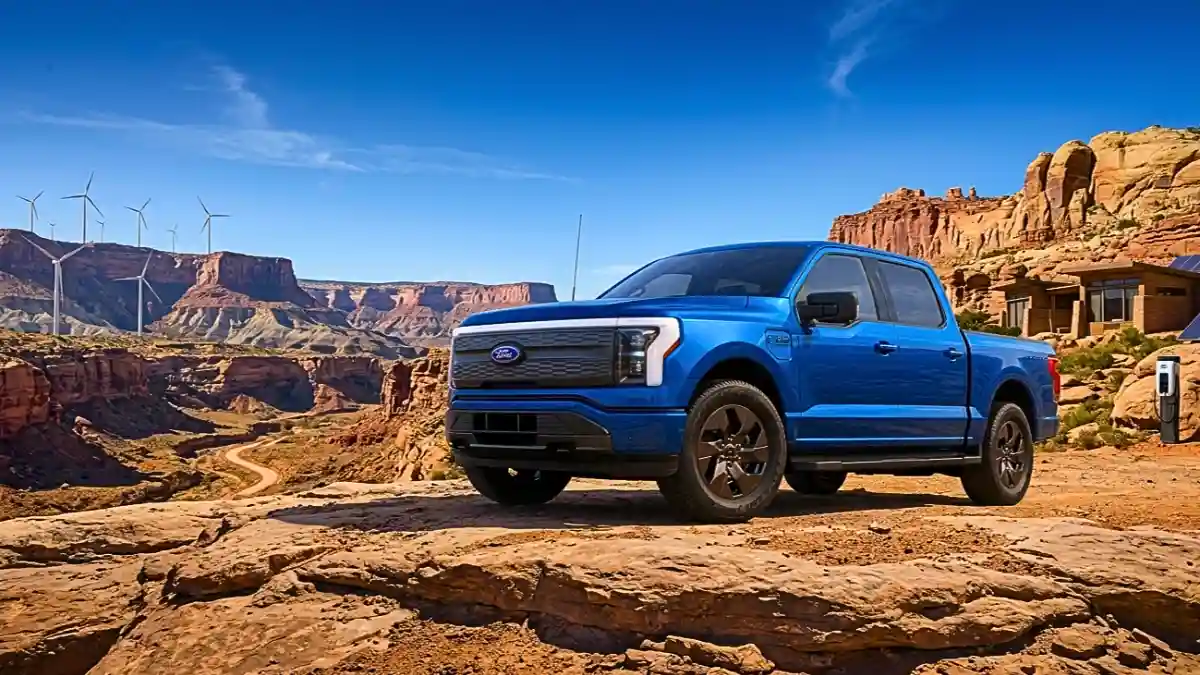
It’s easy to see Ford’s $30000 electric pickup reboot as a sequel. A follow-up to the F-150 Lightning, a “mea culpa” on wheels. But that is the wrong way to look at it. Before a single camouflaged prototype hits the streets of Detroit, this vehicle has already started a much more profound transformation at Ford. It’s not just a new model; it’s a total reboot of how the automaker designs, builds, and thinks about its future.
The Big Picture: The $30,000 electric pickup marks a strategic pivot away from chasing electric versions of traditional heavy-duty trucks toward a smaller, more mass-market vehicle built on a radically simplified platform. It’s a high-stakes gamble by a “skunkworks” team to win the EV market on volume, not just bragging rights.
The Silent Revolution Behind Ford’s $30000 Electric Pickup Reboot
While the EV startups Rivian and Tesla have captured the headlines, Ford has been quietly building what could be its most important vehicle since the Model T, not just for the product, but for the revolutionary philosophy that underpins it.
Ford’s new universal EV platform is a ground-up reinvention of car-making. The company’s Electric Vehicle Development Center (EVDC) in Long Beach, California, is run by a team of around 350 engineers, including veterans from Tesla and Formula 1, tasked with doing what legacy automakers rarely attempt: discarding the rulebook entirely. The group is led by former Tesla engineering director Alan Clarke. Their mission isn’t just to make an electric truck; it’s to make one profitably and sell it for $30,000.
Here’s how they plan to rewrite the rules:
- Zonal Architecture: Traditional vehicles have up to 30 scattered control units managing various functions. The UEV platform consolidates this down to just five powerful main “zonal” modules, slashing software complexity and reducing the wiring harness by 4,000 feet (1.3 km) and cutting 22 pounds (10 kg) of heavy copper wire.
- Megacasting (Also Known as “Unicasting”): To reduce assembly complexity, Ford is adopting Tesla-style “megacasting.” A single large aluminum casting will replace 146 separate stamped metal parts currently found in the gas-powered Maverick’s body structure. This dramatically cuts production time and cost.
- The “Bounty Hunter” Engineering System: In a departure from traditional corporate culture, the Long Beach team operates on a “Total Systems Engineering” approach driven by a unique “Bounty System” that assigns a literal dollar value to every millimeter of height and every gram of weight. This kind of accountability forces critical engineering trade-offs early in the process.
- A 48-Volt Revolution: Ford is moving away from the decades-old 12-volt electrical system to a 48-volt architecture. This allows for thinner, lighter copper wiring and improves efficiency.
These aren’t incremental changes. They are a fundamental restructuring of Ford’s industrial DNA, aimed at building vehicles that compete on price with combustion-engine rivals. The ultimate ambition is to match the production costs of Chinese EV giant BYD’s vehicles built in Mexico, a benchmark that would be game-changing for the US auto industry.
Also Read – Ferrari Luce electric car: Electric Shock Therapy – Why It’s More Than Just a Polarizing EV
Learning From the “Lightning Flop”
Acknowledging failure is the first step toward redemption. And Ford’s leadership has been remarkably candid about the F-150 Lightning’s shortcomings. CEO Jim Farley has publicly admitted the company made a clear “misjudgment” on market demand for the electric full-size truck. In 2025, Ford sold just 27,307 Lightnings compared to over 81,000 Maverick hybrids, a stark signal of where consumer value lies.
The Lightning’s lifecycle was marred by multiple high-profile recalls that eroded trust. In December 2025 alone, Ford recalled over 272,000 vehicles, including 104,113 F-150 Lightnings due to a faulty integrated park module that prevented the transmission from locking into “park”. It was a decisive failure for the electric version of the company’s best-selling nameplate. However, the expensive lessons learned weren’t swept under the rug. They were used as fuel for the Long Beach “skunkworks.” As Chief Financial Officer Sherry House confirmed, prototypes are being built, megacastings are being tested, and supplier readiness assessments are “in full force”.
What to Expect on the Road (And Beyond)
- Testing Schedule: Ford will commence public road testing of its midsize electric pickup in the Detroit area within the next few weeks.
- Specs & Dimensions: The first product from Ford’s new strategy is a four-door midsize pickup (roughly the size of a Ranger/Maverick). Ford is targeting a 0–60 mph time of under five seconds, about the same as a gas-powered Mustang EcoBoost, and a driving range of 300 miles for the entry-level variant.
- The Affordable Price Point: The key to the entire project is the $30,000 starting price, which would undercut the base price of a gas-powered Ford Ranger in the US market. This would make it one of the most affordable new EVs on the market.
- Ford’s Broader EV Roadmap: This is just the first model. Following the midsize pickup, Ford plans to release an affordable small SUV and a sedan on the same platform, with all models targeting a starting price under $30,000.
Also Read – Ferrari Mazda Luce Trademark Dispute: Before Ferrari Could Say “Luce,” Mazda Already Owned the Light
The Bottom Line
Ford’s path forward is no longer about making a single successful electric vehicle. It’s about a complete manufacturing revolution. The $30,000 electric pickup is the symbol of that change, but the real story is the platform and the process.
For consumers, the near-term benefit is a genuinely affordable electric pickup. For the auto industry, it represents a new path to profitability in the EV era that doesn’t rely on $100,000 luxury price tags. For the people of Michigan, the sight of a bizarrely camouflaged pickup on the roads near Detroit in the coming weeks isn’t just a look at a new model. It’s a glimpse at Ford’s last, best chance to shape its future. They’d better get it right.
Also Read – GM Variable Deployment Airbag Patent: The Airbag That Finally Learns Who You Are

Rohit is the visionary behind CarBikeJunction. With over a decade of experience in automotive journalism and a deep love for mechanical engineering, he ensures that every piece of content that goes live meets the highest standards of quality and accuracy. As Editor-in-Chief, he oversees the editorial direction of the website and is often found test-driving the toughest SUVs or analyzing market trends. His leadership is the driving force behind our platform.