


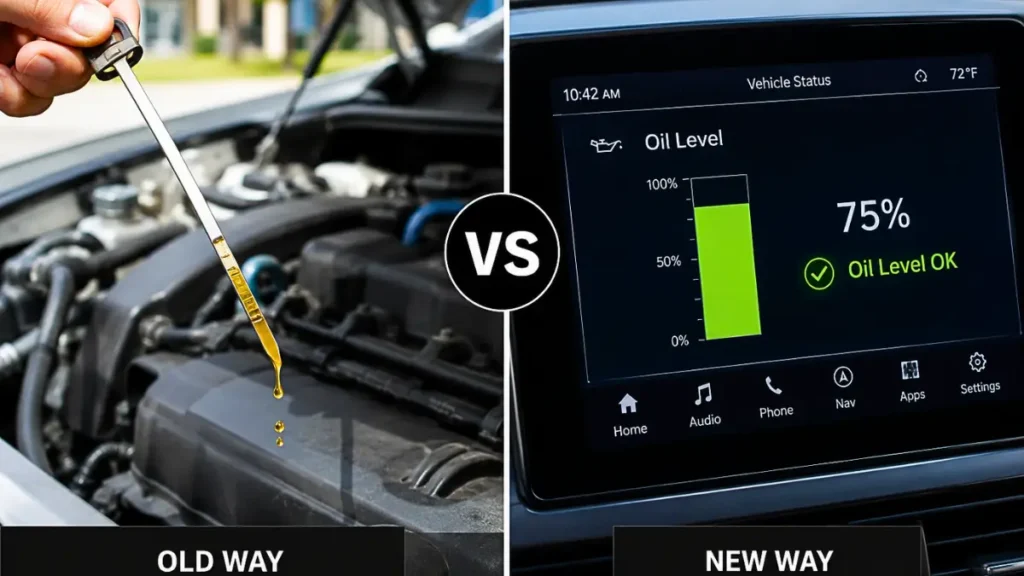

If you’re staring under the hood and can’t find a dipstick, you’re not alone. A growing number of modern vehicles from Ford EcoBoost to Mercedes-Benz and BMW have ditched the traditional dipstick entirely. But low oil is still one of the top causes of catastrophic engine damage, so knowing how to check engine oil level at home without dipstick is genuinely important.
This guide covers every method with and without a dipstick for petrol, diesel, and hybrid cars. We also tackle common brand-specific questions for Ford, Mercedes, Audi, and BMW owners.
What Is a Dipstick, and Why Are Some Cars Getting Rid of It?
A dipstick is a long, thin metal rod inserted into the engine’s oil reservoir. You pull it out, wipe it clean, reinsert it, pull it out again, and read the oil level from the markings on the tip. Simple, reliable, and invented in the early 20th century.
So why are manufacturers removing it? Modern cars increasingly use electronic oil level sensors built directly into the oil pan. These sensors send real-time readings to the dashboard or infotainment system, removing the need for manual checks. According to BMW, Mercedes-Benz, and Audi engineering documentation, this shift is part of a broader move toward fully digital vehicle diagnostics.
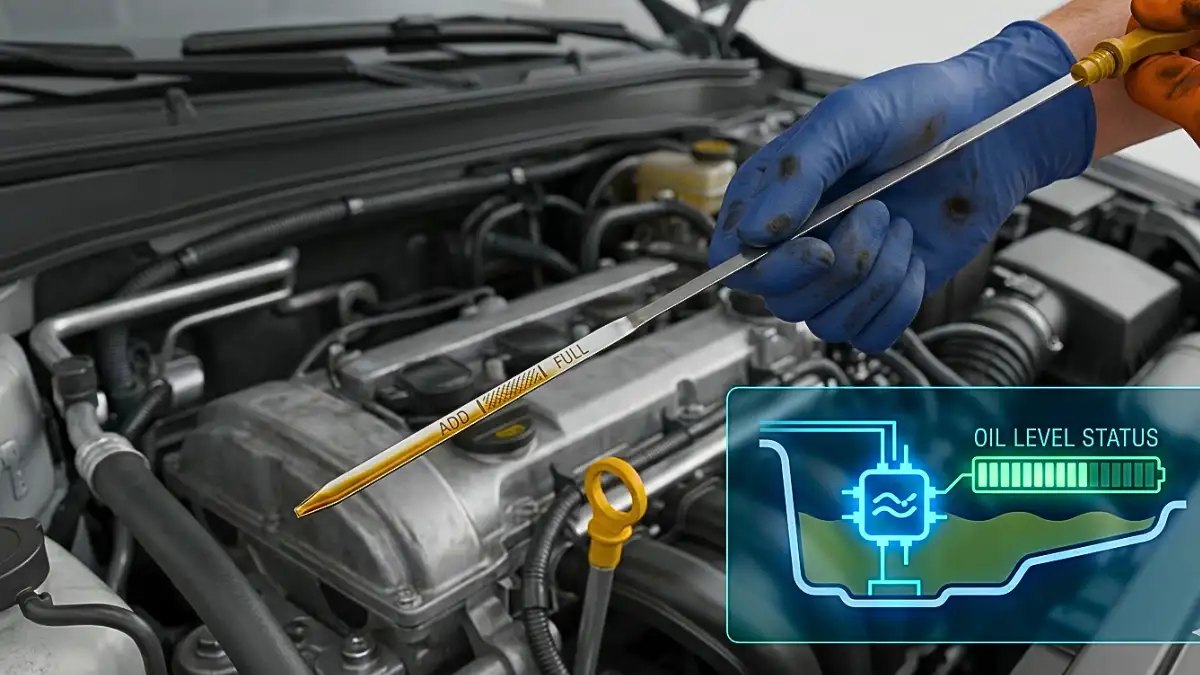
The trade-off? You need to know how to read your car’s specific system and what to do when the sensor fails.
Factual Insight #1: According to AAA (American Automobile Association), low or dirty engine oil is among the leading causes of engine wear, with approximately 22% of engine failures in older vehicles linked to inadequate oil maintenance.
How to Check Engine Oil Level at Home Without a Dipstick
Short answer: Use your car’s onboard oil level monitor via the instrument cluster or infotainment menu. Most modern cars without a dipstick have a digital oil level display accessible through the dashboard menus.
Here’s a step-by-step process that works across most modern vehicles:
Step 1: Park on a Flat Surface
Always check your oil on level ground. Uneven surfaces throw off the sensor reading and give you an inaccurate result. This matters even more for electronic sensors, which calculate oil volume by measuring the level in the pan.
Step 2: Let the Engine Cool (Or Follow Manufacturer Instructions)
This is where it gets brand-specific (more on that below). As a general rule, wait 5–10 minutes after turning the engine off. Some systems require a warm engine, others require a fully cold one.
Step 3: Turn the Ignition On (Without Starting the Engine)
On most cars, you can access oil level readings through the dashboard with the ignition in the “accessory” or “on” position, without the engine running. This activates the electronics without starting the motor.
Step 4: Navigate to the Oil Level Menu
On most modern vehicles, this is found under:
- Vehicle Info → Oil Level (Ford Sync systems)
- Car Menu → Service → Oil Level (Audi MMI)
- Vehicle → Maintenance → Oil Level (Mercedes COMAND/MBUX)
- iDrive → Vehicle Status → Engine Oil (BMW iDrive)

Step 5: Wait for the Reading to Stabilize
The electronic sensor may take 30–60 seconds to give a stable reading. Don’t rush it. If the system says “Check Later” or “Engine Must Be Off for X Minutes,” it’s asking for more settling time.
Step 6: Interpret the Reading
Most systems show:
- A bar graph (min/max range)
- A percentage level
- A simple OK/Low/Add Oil message
If your oil reads below the minimum mark, add the oil type specified in your owner’s manual immediately.
Factual Insight #2: Most manufacturers recommend checking oil every 3,000–5,000 miles for older vehicles and every 7,500–10,000 miles for newer models with synthetic oil. BMW, for example, states that modern BMW engines with Longlife-01 or LL-04 oil may go up to 15,000 miles between changes under ideal conditions.
How to Check Engine Oil Level Without a Dipstick in Ford Vehicles
Ford started removing traditional dipsticks from several engines starting with the EcoBoost lineup around 2011–2012. Models like the Ford F-150 with certain EcoBoost trims, the Escape, and the Explorer have electronic oil level monitoring.
Here’s how to check oil level without a dipstick in a Ford:
- Park on a flat surface and turn the engine off.
- Wait at least 5 minutes for oil to drain back into the pan.
- Turn the key to the “On” position (or press the Start button once without pressing the brake).
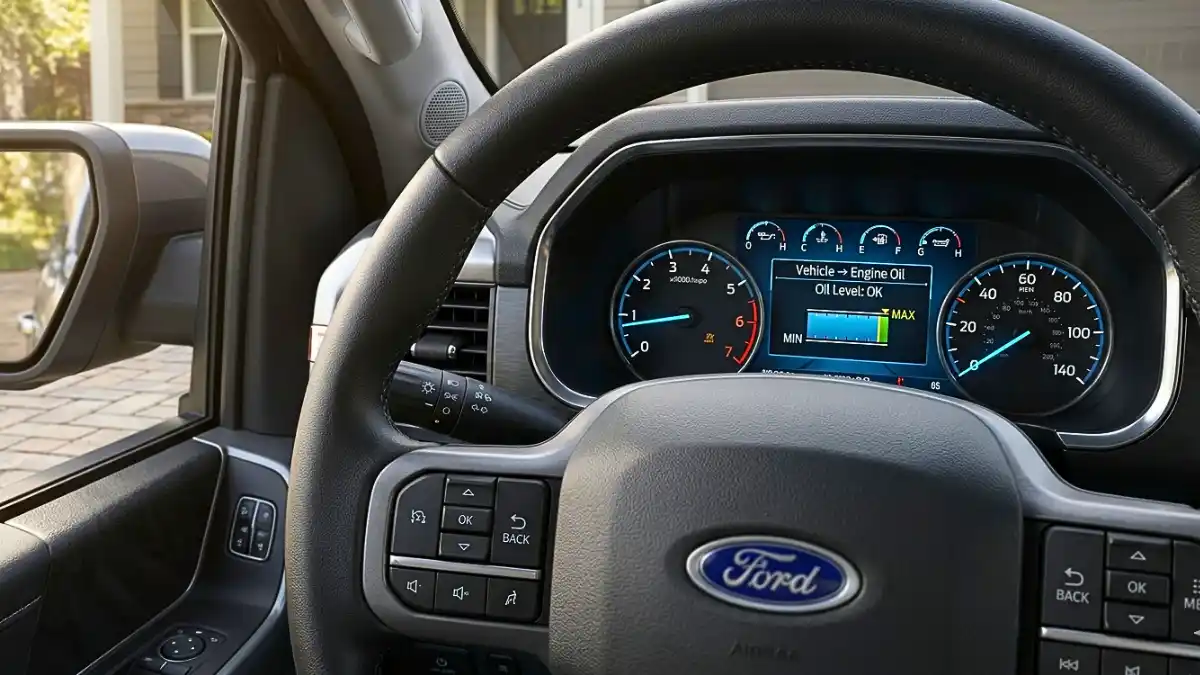
- Press the left or right arrow on the steering wheel controls to navigate to “Vehicle” on the instrument cluster.
- Select “Oil Life” or “Engine Oil” depending on your model year.
- The display will show current oil level and oil life percentage.
On newer Ford models with the Sync 4 system, you can also access this through the center touchscreen under Settings → Vehicle → Engine Information.
Factual Insight #3: Ford’s EcoBoost 2.7L and 3.5L V6 engines used in the F-150 and Edge ST are factory-filled with 5W-30 synthetic oil and have no traditional dipstick from the factory. Ford’s owner manuals confirm that oil level checking is entirely electronic on these trims.
Important warning for Ford owners: If the electronic sensor malfunctions, you won’t get an accurate reading. In that case, the only reliable fallback is having a mechanic use a scan tool to read the sensor data or physically measuring oil using a clean flexible hose inserted into the dipstick tube opening (if the tube is still present).
How to Check Oil Level Without a Dipstick in Mercedes-Benz
Mercedes-Benz removed traditional dipsticks from most of its petrol engines by the mid-2010s. If you own a C-Class, E-Class, GLC, or GLE from 2014 onwards, you’re almost certainly dealing with an electronic system.
Mercedes Oil Level Check Step by Step:
- Park on a level surface and switch off the engine.
- Wait 5–10 minutes to allow oil to settle. Mercedes specifically recommends waiting at least 5 minutes.
- Open the COMAND or MBUX system.
- Navigate to Vehicle → Maintenance → Oil Level.
- The display will show a graphic of an oil tank with the level marked, plus a message like “Oil Level OK” or “Add 0.5L of Oil.”

Alternatively, on older models with the classic instrument cluster, press and hold the trip reset button on the left stalk until the service menu appears, then navigate to oil level.
Factual Insight #4: Mercedes-Benz vehicles typically use fully synthetic 5W-30 or 0W-40 oil conforming to the MB 229.5 or 229.51 spec. Using the wrong spec can damage the engine and void the warranty. Always verify the exact specification in your owner’s manual or the oil filler cap.
Mercedes Oil Level Check Dipstick (for Older Models)
If you have a pre-2010 Mercedes-Benz, you likely do have a dipstick, usually yellow or orange, located near the front of the engine bay. The procedure is the same as any traditional dipstick check (covered in the next section). Mercedes dipstick markings are typically labelled with MIN and MAX or use a hatched zone to indicate the acceptable range.
How to Check Audi Oil Level Without a Dipstick
Audi is one of the most prominent brands to fully eliminate dipsticks. Models from the A3 to the A8, including Q-series SUVs, use Audi’s electronic oil level display as standard.
Audi Oil Level Check Step by Step:
- Park on a flat, level surface.
- Turn the engine off and wait 2 minutes (Audi’s own recommendation in the owner’s manual).
- Turn the ignition to position 2 (lights on, engine off).
- On the MMI (Multi Media Interface), press the Car button, then go to Servicing & Checks → Oil Level.
- The system displays a bar-style graphic showing the current oil level, from minimum to maximum.

On Audi models with Virtual Cockpit, the oil level is also accessible by pressing the “CAR” shortcut on the steering wheel and selecting vehicle status.
Factual Insight #5: Audi’s 2.0 TFSI engine, used across A4, A5, Q5, and numerous other models, is known for higher-than-average oil consumption. Audi acknowledges in official documentation that consumption of up to 0.5 liters per 600 miles can be within spec for some of its petrol engines. This makes regular oil level checks especially important.
How to Check BMW Oil With or Without a Dipstick
BMW is an interesting case. Unlike Audi and Mercedes, some BMW models actually do still have a physical dipstick, but not all of them, and the presence of one depends on the engine variant and model year.
How to Check BMW Oil With a Dipstick
Older BMWs (pre-2010, and some N-series engines) have a traditional red-handled dipstick:
- Park on a flat surface, engine off.
- Wait 5 minutes after turning off the engine.
- Pull out the dipstick, wipe with a clean cloth, reinsert fully.
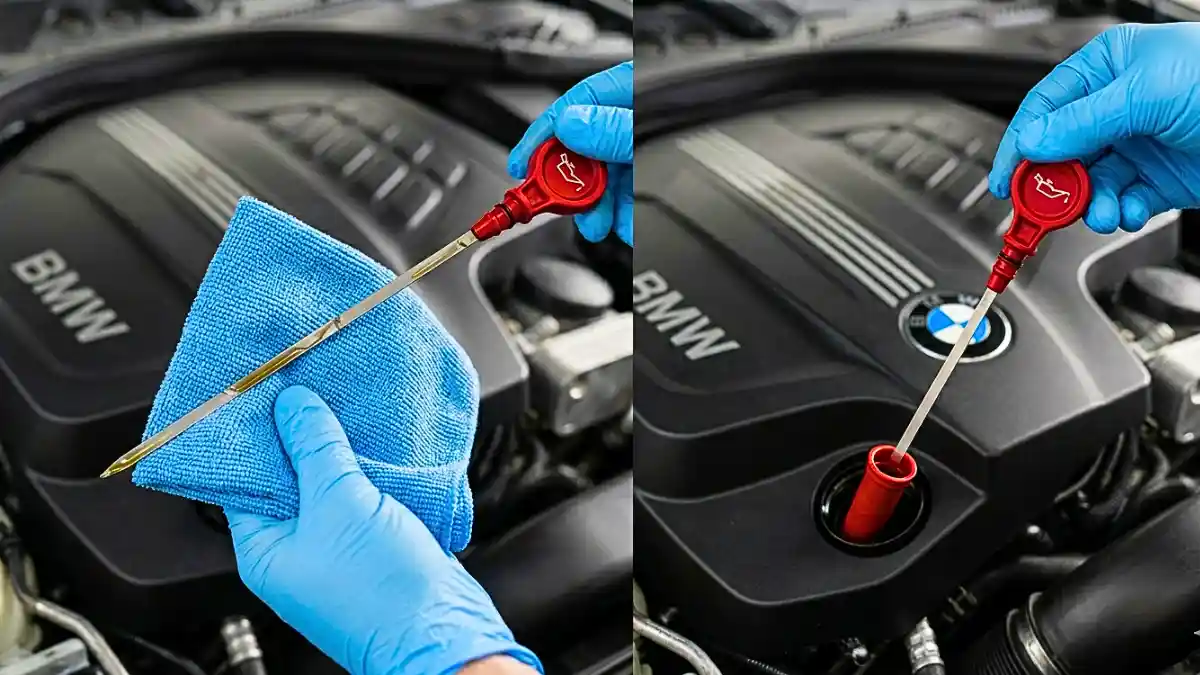
- Pull it out again. Read the oil level – it should be between the MIN and MAX marks.
- If oil is close to or below the MIN mark, add oil slowly, checking frequently to avoid overfilling.
How to Check BMW Oil Without a Dipstick (iDrive)
For BMWs with the Condition Based Service (CBS) system and no physical dipstick:
- Start the engine and let it warm up for 2–3 minutes (BMW recommends a warm engine for an accurate reading).
- Turn the engine off.
- Wait 5 minutes.
- Turn the ignition on (don’t start the engine).
- On the iDrive display, go to Vehicle Information → Vehicle Status → Engine Oil.
- A level indicator will appear showing whether the oil is in the safe zone.

Factual Insight #6: BMW’s N20, N52, and S55 engines do not have traditional dipsticks. BMW’s Condition Based Service system monitors oil level electronically and alerts the driver when the oil drops by approximately one quart below the maximum.
How to Check Oil With a Dipstick (Traditional Method)
Even in 2026, millions of cars still use a traditional dipstick. Here’s the definitive process if your car has one:
Step-by-Step Guide to Reading an Engine Oil Dipstick:
- Park on level ground and switch off the engine. Let it sit for at least 5 minutes so the oil drains back into the sump.
- Open the bonnet (hood) and locate the dipstick. It usually has a brightly coloured handle – yellow, orange, or red.
- Pull the dipstick out completely and wipe it clean with a lint-free rag or paper towel.
- Reinsert the dipstick fully into its tube, making sure it’s pushed all the way in.
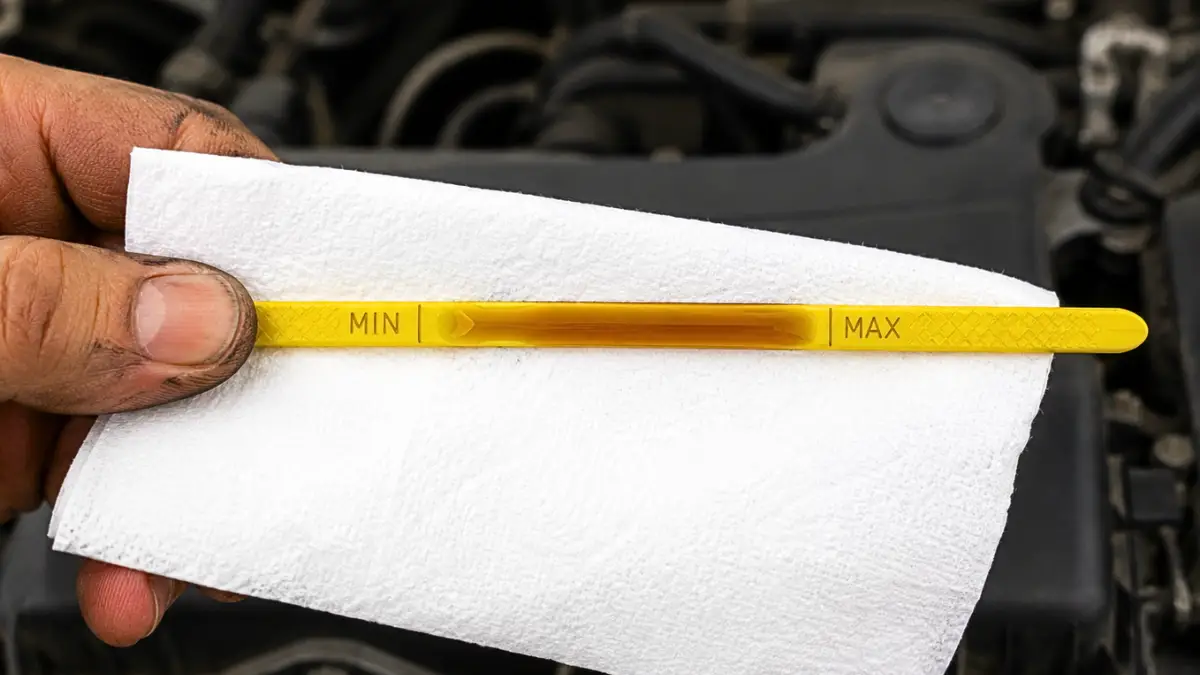
- Pull it out again and hold it horizontally, away from you, to read the level.
- Read the markings. The oil film should be between the MIN (or “L”) and MAX (or “H/F”) marks. The ideal level is close to MAX without going over.
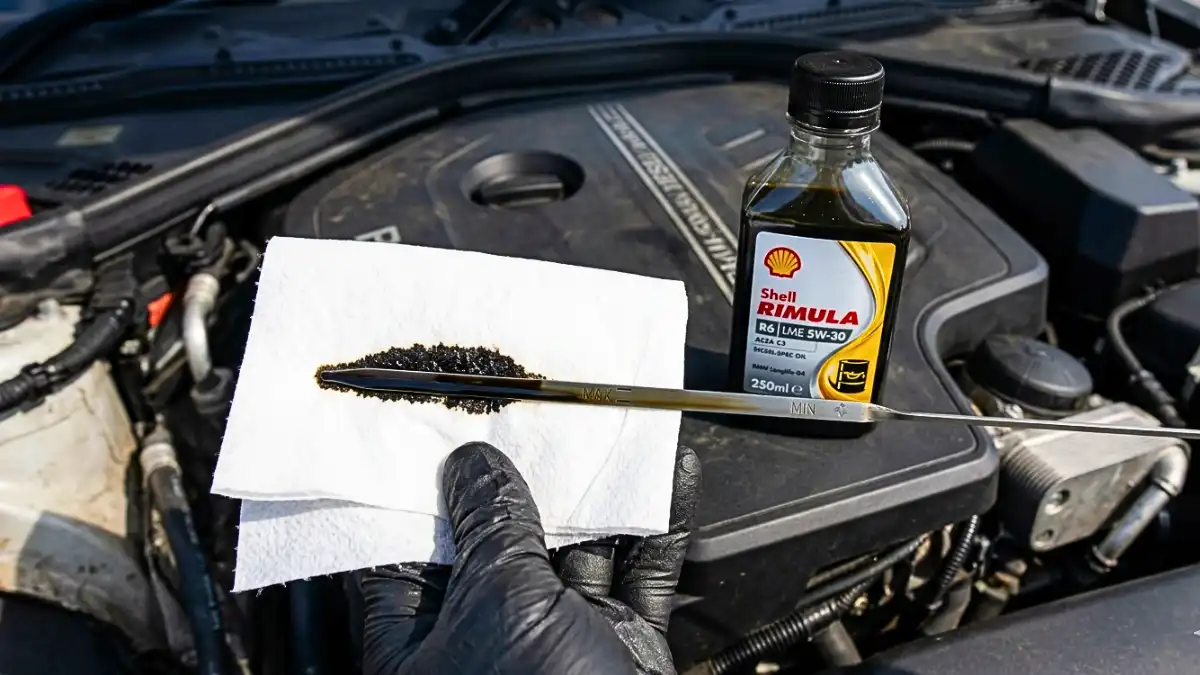
- Check the oil colour. Fresh oil is golden-amber. Dark brown is normal ageing. Black and gritty means it’s overdue for a change. Milky or frothy oil could indicate a head gasket problem; see a mechanic.
Can’t See Oil Level on Dipstick?
This is a common frustration. If you pull the dipstick and either see no oil film at all or the level appears in the middle but is hard to read, try these tips:
- Wipe and reinsert twice. The first wipe removes splash; the second reading is more accurate.
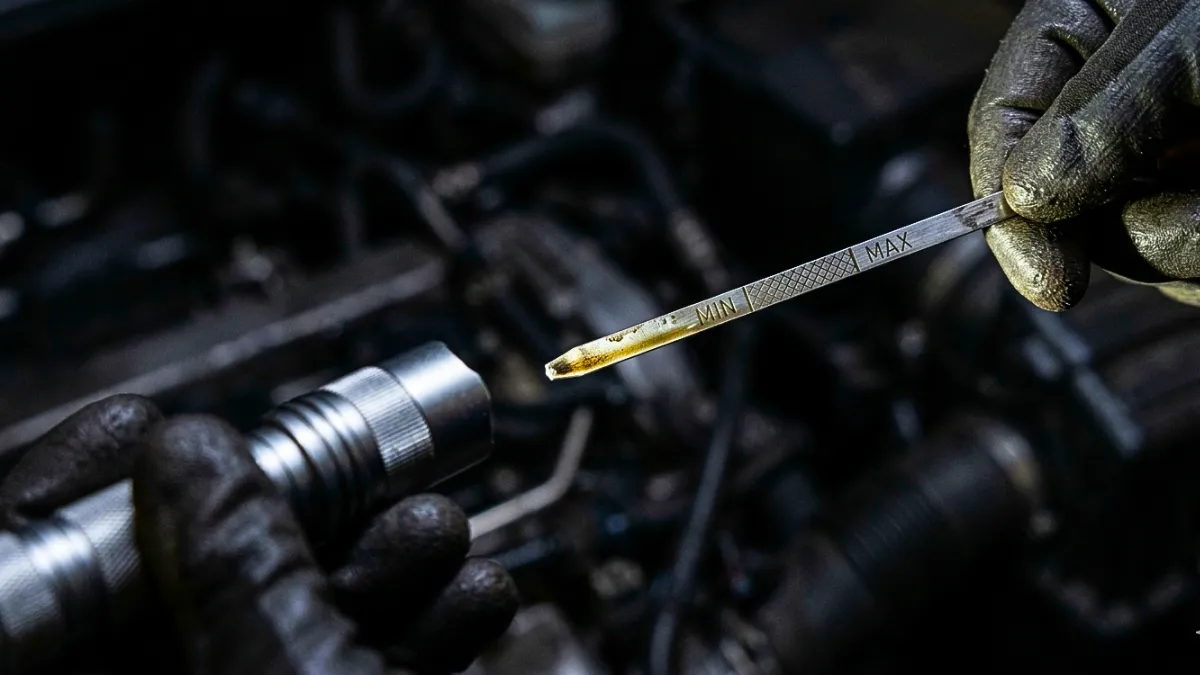
- Hold the dipstick under good light or use a torch (flashlight). Oil on a clean metal rod can be hard to spot.
- Inspect the texture, not just the level. If you can’t see the oil, it may be below the MIN mark, which means add oil immediately.
- Check for a foam or emulsion. Foamy oil suggests water contamination. Stop driving and get the car inspected.
Factual Insight #7: According to Castrol’s 2023 global engine oil study, approximately 1 in 3 cars on the road is running with engine oil that is either too low or too dirty. Regular checks remain one of the single most cost-effective ways to extend engine life.
How to Check Engine Oil Level in a Diesel Car
Diesel engines have a few quirks that make oil checks slightly different from petrol cars.
Key differences:
- Diesel engines tend to consume and contaminate oil more quickly due to soot and higher combustion pressures.
- Diesel oil turns black very quickly. This is normal and doesn’t necessarily mean the oil needs changing.
- Some modern diesel engines (especially Euro 6 diesels) have Diesel Particulate Filters (DPFs), which can cause oil dilution through regeneration cycles. This makes it especially important to check the oil level regularly, not just the oil condition.
The checking process is the same as above. However, for diesel:
- Never overfill a diesel engine – it can cause runaway acceleration (the engine feeds off excess oil as fuel). This is a real safety risk.
- Add oil in small increments (0.25–0.5 litre) and recheck between additions.
- If the oil smells of fuel or feels unusually thin on the dipstick, investigate further – it could indicate fuel dilution.
Factual Insight #8: The EU’s Euro 6d emission standard (fully enforced since January 2021) requires diesel vehicles to pass strict NOx and particulate limits. This has led to more complex DPF and EGR systems that can, under certain driving conditions, dilute engine oil with diesel fuel – making frequent level checks even more important for diesel owners in urban stop-start driving environments.
Do You Check Engine Oil When the Car Is Hot or Cold?
This is one of the most commonly Googled questions about engine oil, and the answer depends on the type of system your car uses.
For traditional dipstick cars: Check oil when the engine is cold or slightly warm, ideally at least 30 minutes after the last drive. A cold engine allows all oil to drain fully back into the sump, giving the most accurate reading. If you check immediately after driving, residual oil on the cylinder walls and oil passages can give you a falsely high reading.

For electronic sensor systems (BMW, Audi, Mercedes): The recommendation varies by brand. BMW specifically recommends checking with a warm engine (after a short drive), while Audi and Mercedes generally recommend checking with the engine cold and settled for a few minutes. Always consult your owner’s manual first; it overrides general advice.
General rule of thumb: If in doubt, cold is safer for a dipstick check. Warm (but off) is better for electronic sensors.
How Long Can You Drive Without a Dipstick Tube?
If your dipstick tube is missing, broken, or has been left off after a service, driving is risky, but the timeline is shorter than most people expect.
The dipstick tube serves as a seal for the oil system. Without it, the opening into the crankcase is exposed. At engine speed, this means:
- Oil mist and vapour can escape, coating the engine bay with a thin film of oil.
- Debris and dirt can enter the crankcase, contaminating the oil.
- Depending on your engine’s crankcase pressure, oil can actively pump out of the opening.
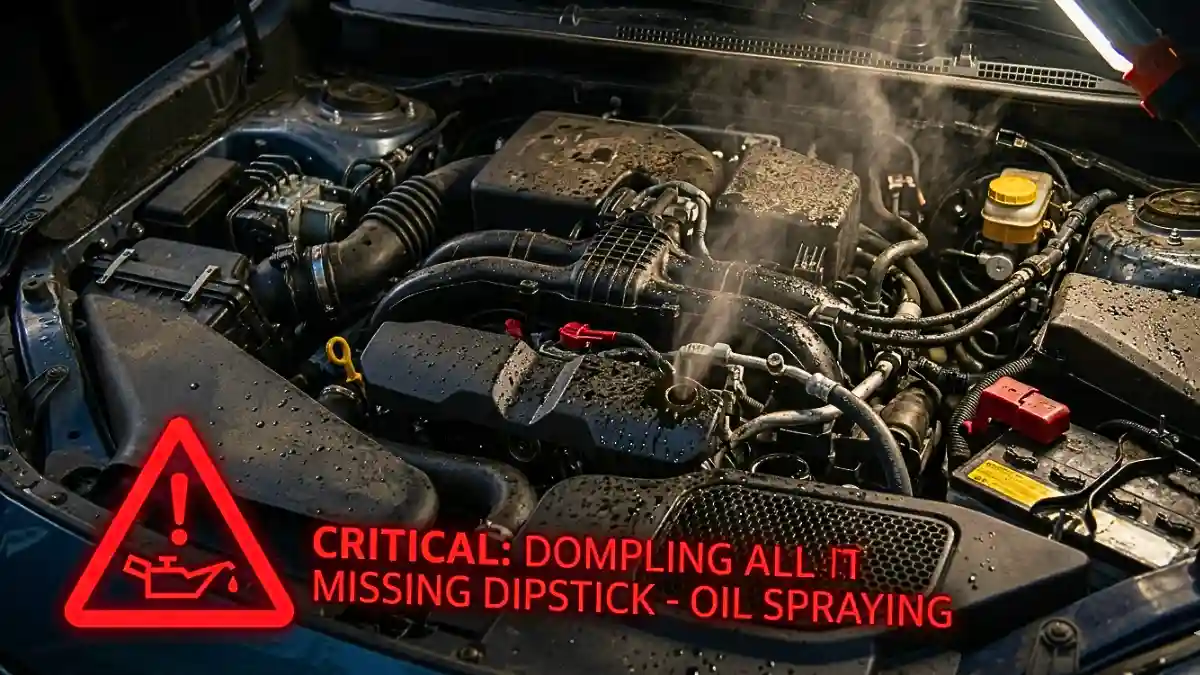
In practical terms: driving for more than a few miles without a dipstick tube in place is not recommended. Oil loss can be rapid, and debris ingestion can begin immediately. If you discover the tube is missing after a service, return to the garage immediately.
Factual Insight #9: A dipstick tube left loose or unseated after an oil change is a surprisingly common service error. If your car smells of burning oil after a recent service or you see oily residue in the engine bay, this should be your first check.
Can Low Oil Cause Engine Stuttering?
Yes, and it’s more serious than most people realise. Low engine oil affects lubrication across the entire engine. When the oil level drops below a critical threshold, here’s what can happen:
What happens when oil is too low:
- Oil starvation at the crankshaft and camshafts causes metal-to-metal contact, leading to rough, inconsistent engine operation.
- Variable Valve Timing (VVT) systems, which rely on oil pressure to function, begin to operate erratically, causing stuttering, misfires, or hesitation, especially at low RPMs.
- Hydraulic lifters, used in many engines, flatten out without adequate oil pressure, causing a tapping or stuttering sound.
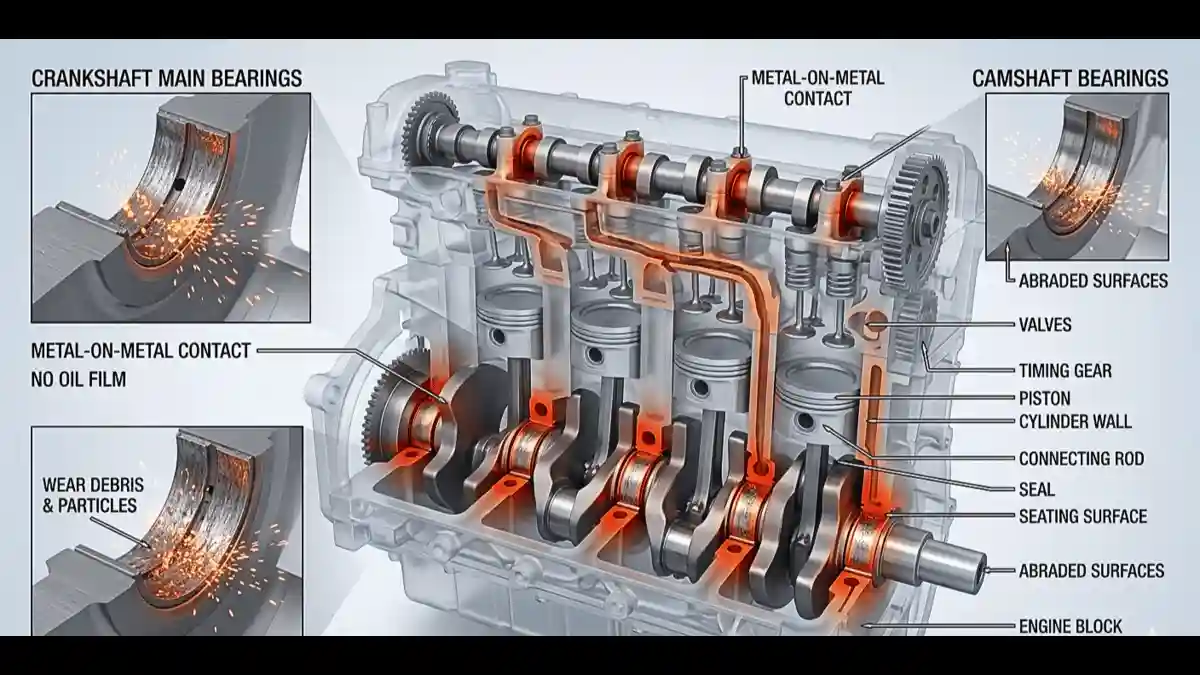
So yes, low oil can absolutely cause stuttering, rough idle, hesitation under load, and ultimately, if ignored, full engine seizure.
What stuttering caused by low oil usually feels like:
- Rough or lumpy idle
- Hesitation when accelerating from a stop
- A rattling or tapping from the engine (especially on cold starts)
- Oil warning light (but note: this light often only illuminates when pressure is critically low after damage may already be occurring)

Factual Insight #10: The oil pressure warning light in most vehicles activates at around 4–7 PSI, which is well below the normal operating pressure of 25–65 PSI. By the time the warning light comes on, the engine is already under serious stress. Don’t wait for the light; check oil levels proactively.
How to Check Engine Oil in a Diesel Car Using a Dipstick Step-by-Step
Many diesel cars, particularly older ones (pre-2015), still use traditional dipsticks. The process follows the same general steps, with a few diesel-specific notes:
- Turn off the engine and wait 10 minutes. Diesel engines run hotter, and oil takes longer to settle.
- Locate the dipstick, usually marked with an oil can symbol, often yellow-handled.
- Pull, wipe, reinsert, and pull again as described earlier.
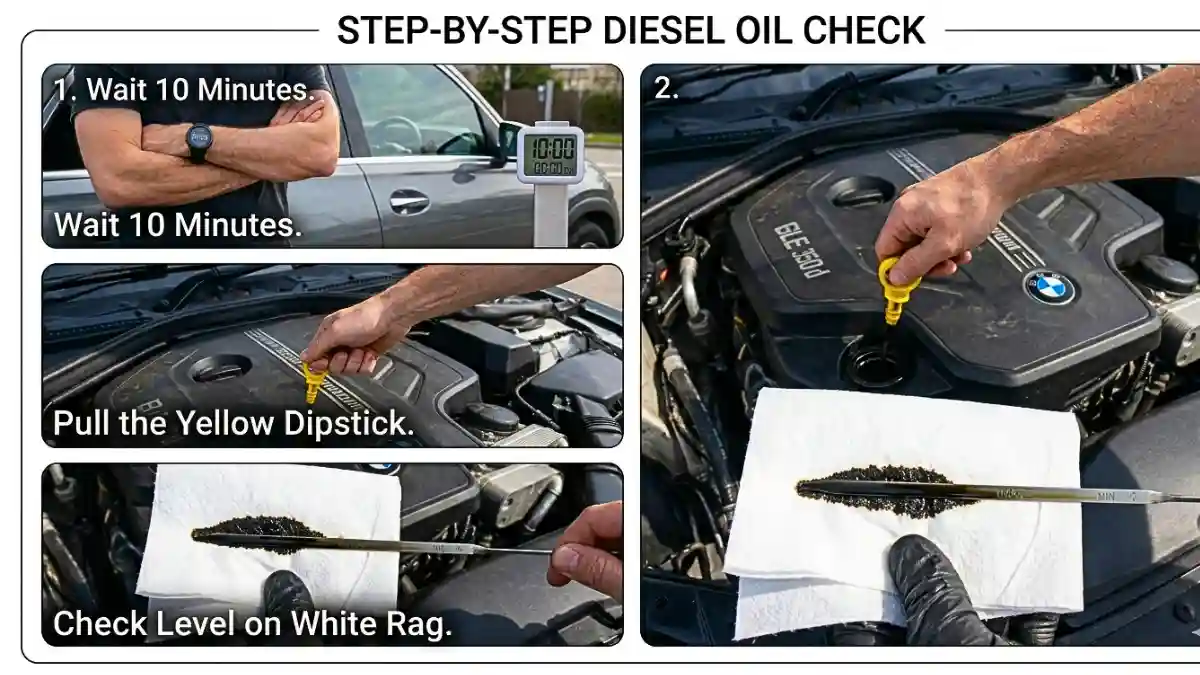
- Read the level carefully. Diesel oil turns black very fast. This doesn’t mean it’s bad, but it can make the level harder to read on the dipstick. Tilt the stick toward good light.
- Top up carefully using the correct diesel-spec oil (look for ACEA C3 or the specific OEM approval listed in your manual).
Pro tip: For diesel cars, use a white or light-coloured rag when wiping the dipstick. Dark diesel oil on a dark rag makes it very hard to read the level; a light cloth shows the oil boundary more clearly.
Quick Reference: Oil Checking Methods by Brand
| Brand | Has Dipstick? | How to Check Without Dipstick |
| Ford (EcoBoost) | No (most) | Sync system → Vehicle → Engine Oil |
| BMW (post-2008) | Some models | iDrive → Vehicle Status → Engine Oil |
| Mercedes-Benz (post-2014) | No (most) | COMAND/MBUX → Vehicle → Maintenance → Oil Level |
| Audi (post-2012) | No | MMI → Car → Servicing → Oil Level |
| Toyota/Honda/Hyundai | Yes (most) | Traditional dipstick method |
| Volkswagen (newer models) | No (some) | MFD display → Oil Level |
What to Do if Your Electronic Oil Level Sensor Fails
Electronic systems are reliable until they aren’t. Sensor failures do occur, and when they do, you may get a “System Unavailable” message or a falsely reassuring “Oil Level OK” reading even when oil is low.
Signs your oil level sensor may be faulty:
- Persistent “Check Oil Level” message even after topping up correctly
- Reading doesn’t change after adding oil
- Message disappears and reappears randomly

What to do:
- Have the sensor read with an OBD-II scanner for fault codes.
- Visit your dealership or a trusted independent garage. Sensor replacement is usually a straightforward job.
- In the interim, do not rely solely on the dashboard. If your car doesn’t have a dipstick, ask a mechanic to physically verify the oil level using a workshop inspection tool.
Summary: The Key Things to Remember
Checking engine oil is one of the simplest and most neglected maintenance tasks you can do. Here’s the short version:
- No dipstick? Use your car’s onboard display via the instrument cluster or infotainment menu. Check for Ford, Mercedes, Audi, and BMW-specific menus described above.
- Have a dipstick? Pull, wipe, reinsert, pull, read. Check cold, on flat ground, after the engine has settled.
- Check the colour and consistency. Golden is good, black is okay, milky is bad, gritty means a change is overdue.
- Low oil can cause stuttering – don’t wait for the warning light.

- Diesel owners need to check more frequently and never overfill.
- Missing dipstick tube? Don’t drive – return to the garage immediately.
Checking your oil takes less than 2 minutes and can save you from a multi-thousand dollar engine repair. It’s the easiest car maintenance habit you can build.
Sources & References:
- AAA Foundation for Traffic Safety – Engine Failure Research
- BMW Group Owner’s Manual Documentation (BMW i Series, 3 Series, 5 Series)
- Audi Owner’s Manual (A4, A5, Q5 — 2020–2025 editions)
- Mercedes-Benz MBUX User Guide (2021–2025)
- Ford Owner’s Manual for EcoBoost 2.7L and 3.5L Engines
- Castrol Global Engine Oil Survey, 2023
- European Commission – Euro 6d Emission Standards, EUR-Lex
- SAE International – Engine Oil Pressure and Lubrication Technical Standards
FAQ –
1. How often should I check my engine oil level?
Ans – For most cars, checking once a month is sufficient. If you drive a high-mileage vehicle, own an Audi with a known consumption issue, drive a diesel in urban conditions, or frequently tow or haul heavy loads, check every two weeks or every 1,000 miles.
2. What happens if I overfill the engine with oil?
Ans – Overfilling is actually dangerous. Excess oil can be churned into foam by the crankshaft, reducing its lubricating properties. It can also build pressure that forces seals and gaskets to fail, and in diesel vehicles, too much oil can be sucked into the combustion process, causing runaway acceleration. Always fill to the MAX mark – no more.
3. Can I check oil immediately after driving?
Ans – Technically, yes, but you won’t get an accurate reading on a dipstick car because oil residue coats the cylinder walls and passages. For the most accurate result, wait at least 5–10 minutes after a short drive, or check before starting the engine in the morning.
4. What does it mean if my oil looks milky or creamy?
Ans – Milky or frothy oil usually means coolant is mixing with the oil – often a sign of a blown head gasket or, in severe cases, a cracked engine block. This is a serious problem. Stop driving immediately and have the car inspected.
5. Is it normal to add oil between services?
Ans – Yes, for many cars – especially those that use synthetic oil and have tight tolerance engines. BMW and Audi, in particular, both acknowledge that some consumption between services is within normal parameters. The key is to top up when needed rather than waiting until the next scheduled service.
Also Read – Which is Better Brezza or Nexon for Family, City & Highway? 2026 Guide


Raj is the creative mind curating the special content for the website. From exclusive first-drive reviews to buyer’s guides and comparison tests, Raj ensures our features are engaging and helpful. He loves getting behind the wheel of new launches and creating content that helps our readers pick their dream vehicle. His passion for motorcycles and performance cars is evident in his energetic writing style.