


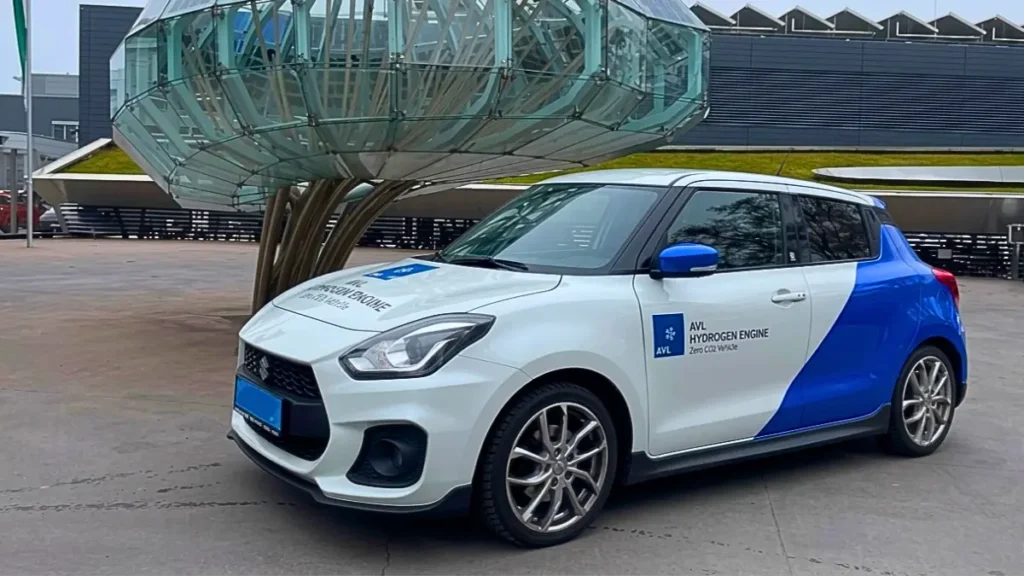

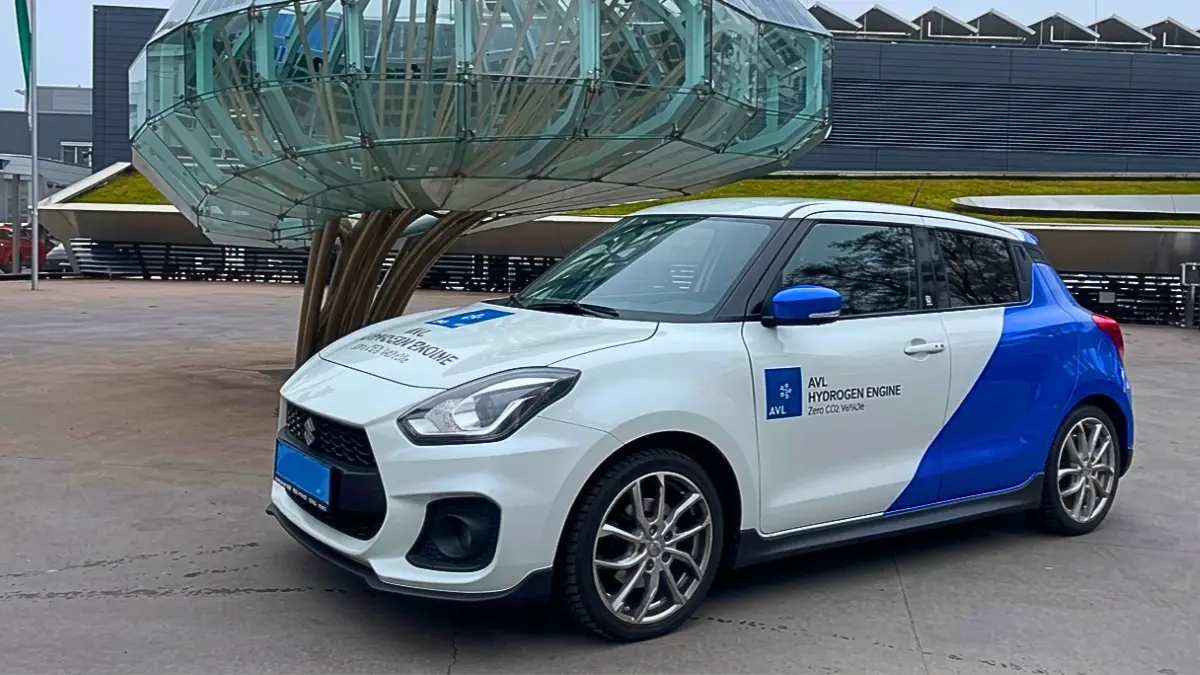
Alright folks, if you thought the Maruti Suzuki Swift had run out of surprises after getting hybrid tech abroad, hold onto your seat. Suzuki just dropped something nobody saw coming — a fully drivable Swift that runs on hydrogen. And no, it’s not some science fair model with a tiny fuel cell; it’s packing a proper hydrogen-burning internal combustion engine under the hood. I know, right? Let’s break down what this Hydrogen-Spec Swift is all about, why it actually matters, and whether we Indians will ever see anything like it on our roads.
A hydrogen Swift? Wait, how did that happen?
Last month, at the 47th International Vienna Motor Symposium, Austrian powertrain specialist AVL rolled out a heavily modified Suzuki Swift alongside the Japanese carmaker itself. This wasn’t some static concept gathering dust — it was a real, working prototype built purely as a technology demonstrator. AVL took the second-generation Swift (the one that was sold internationally and still looks sharp, honestly) and completely reworked it to sip hydrogen instead of petrol.
Now, before we get carried away, let’s be clear: this is not going into production tomorrow. The car is essentially an engineering statement, designed to test if hydrogen combustion can work in a small, affordable hatchback. But the fact that Suzuki even greenlit this experiment on the Swift platform is pretty exciting for us Maruti Suzuki Swift fans.
Combustion, not fuel cells — here’s the clever bit
Most hydrogen vehicles you hear about, like the Toyota Mirai or Hyundai Nexo, use fuel-cell technology, where hydrogen produces electricity to power the motor. It’s super efficient but also super expensive. AVL and Suzuki went a different, far more pocket-friendly route: they kept the internal combustion engine but fed it hydrogen directly.
The engine in question is a 1.4-litre direct-injection unit tuned exclusively for hydrogen. AVL’s boffins calibrated it to work in two distinct combustion modes — lean-burn and Lambda=1 stoichiometric. In plain English, lean-burn means running the engine with extra air to maximise efficiency and keep emissions almost negligible, while the Lambda=1 mode uses a proper stoichiometric air-fuel ratio to extract more grunt whenever the driver demands it.
To handle the extra heat and NOx production when running Lambda=1, the engine gets a cooled EGR system that recirculates exhaust gases and keeps combustion temperatures in a safe, clean zone. When you switch to this high-performance mode, the engine delivers a punchy 100 kW (that’s 134 hp) and 220 Nm of torque — a solid 10 kW and 20 Nm jump over the lean-burn setting. Not bad for a little hydrogen-breathing hatchback, eh?
What does this mean for the Maruti Suzuki Swift in India?
Let’s bring it closer home. Our beloved Maruti Suzuki Swift is already the gold standard for practical hatchbacks, and while this hydrogen prototype is based on the older Mk2 platform sold overseas, it’s still a Swift at heart. It shows that Suzuki is seriously tinkering with alternative fuels even for small, low-cost cars — exactly the kind of segment where India rules the roost.
However, don’t start saving for a Hydrogen-Spec Swift just yet. Suzuki currently has no plans to launch a hydrogen-powered Swift in Europe, Japan, or anywhere else. The tech is still eye-wateringly expensive to scale down, and India’s hydrogen refuelling infrastructure is virtually non-existent.
Instead, Maruti Suzuki is playing the practical card. Word on the street is that by 2027, we’ll get a series-hybrid version of the Maruti Suzuki Swift right here in India. It’ll use the new Z12E 1.2-litre three-cylinder petrol engine as a generator to charge the battery, with the wheels driven by an electric motor. Expected fuel economy? An insane 35 km/l, which would make the Swift one of the most efficient petrol cars on the planet. That’s a far more realistic and exciting near-future upgrade for us.
So, will we ever see a hydrogen Maruti Suzuki Swift?
Honestly, not in this decade. But the fact that Suzuki chose the Swift as the canvas for this hydrogen experiment tells me two things: first, the Swift platform is so versatile that it can even embrace bleeding-edge green tech; second, Suzuki hasn’t put all its eggs in the EV basket. Hydrogen combustion may very well turn out to be a smart, affordable bridge for entry-level cars in markets like ours, provided the fuelling network catches up.
For now, this Hydrogen-Spec Swift is a glorious what-if — a 134 hp, torque-filled science project that reminds us why we fell in love with the Swift name in the first place. It’s lightweight, no-nonsense, and apparently ready to swallow any fuel you throw at it. I’ll keep dreaming about a future where my local Maruti Suzuki Swift can fill up on clean hydrogen and still give me that peppy, fun-to-drive character. Until then, the hybrid version coming in 2027 is the realistic next step — and honestly, I’m all for it.
What do you make of this hydrogen Swift concept? Too far-fetched, or the kind of future Maruti Suzuki should seriously chase? Drop your thoughts below, and let’s geek out together.
Also Read – Maruti Eeco Star Edition Launched: 19 Accessory Upgrades for ₹19,999 – Is the Old Workhorse Worth It?


If it runs on electricity or has a microchip, Rahul is on it. As our resident tech geek and electric vehicle (EV) specialist, Rahul decodes complex technologies into simple language for our readers. He stays ahead of the curve on battery technology, autonomous driving, and the latest digital trends in the automotive sector. If you want to know the real range of an EV or the future of mobility, Rahul has the answers.