


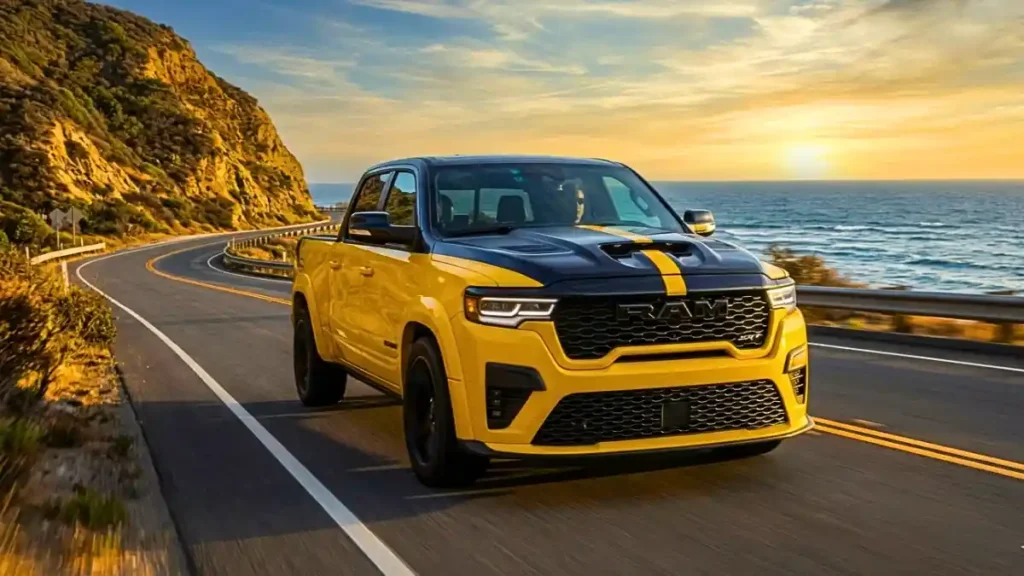

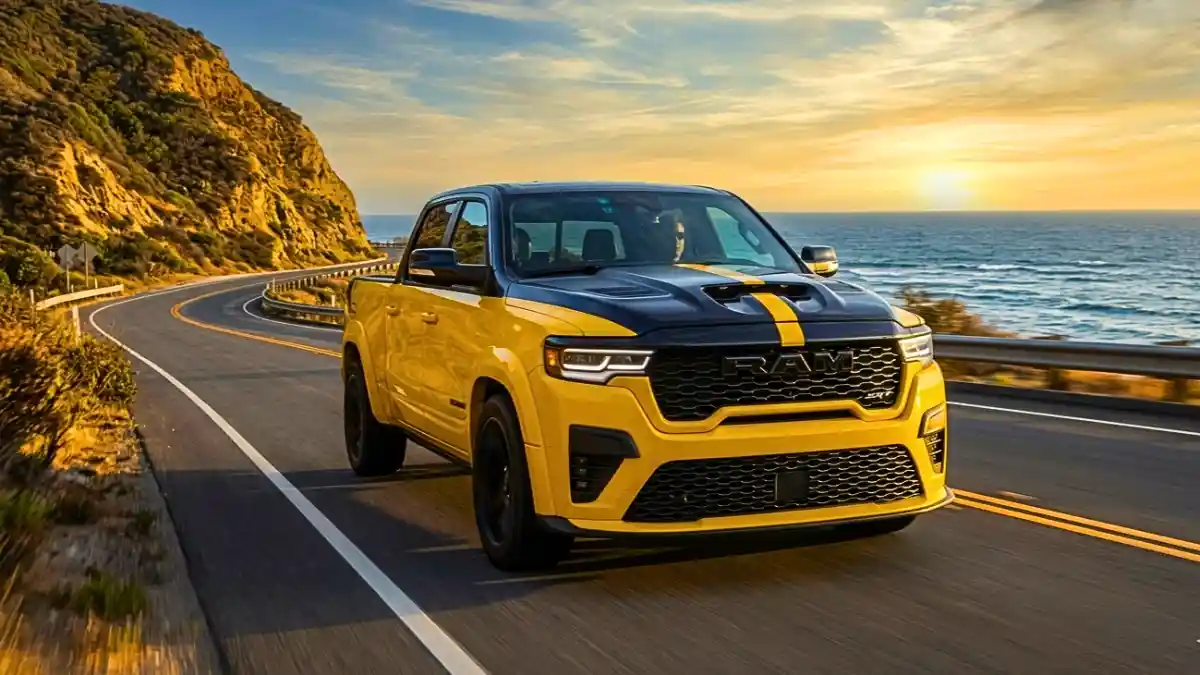
With the Ram 1500 Rumble Bee, Ram isn’t chasing off-road glory. It’s making a calculated bet that America’s truck buyers have been quietly waiting for a vehicle that goes fast on asphalt and looks terrifying doing it.
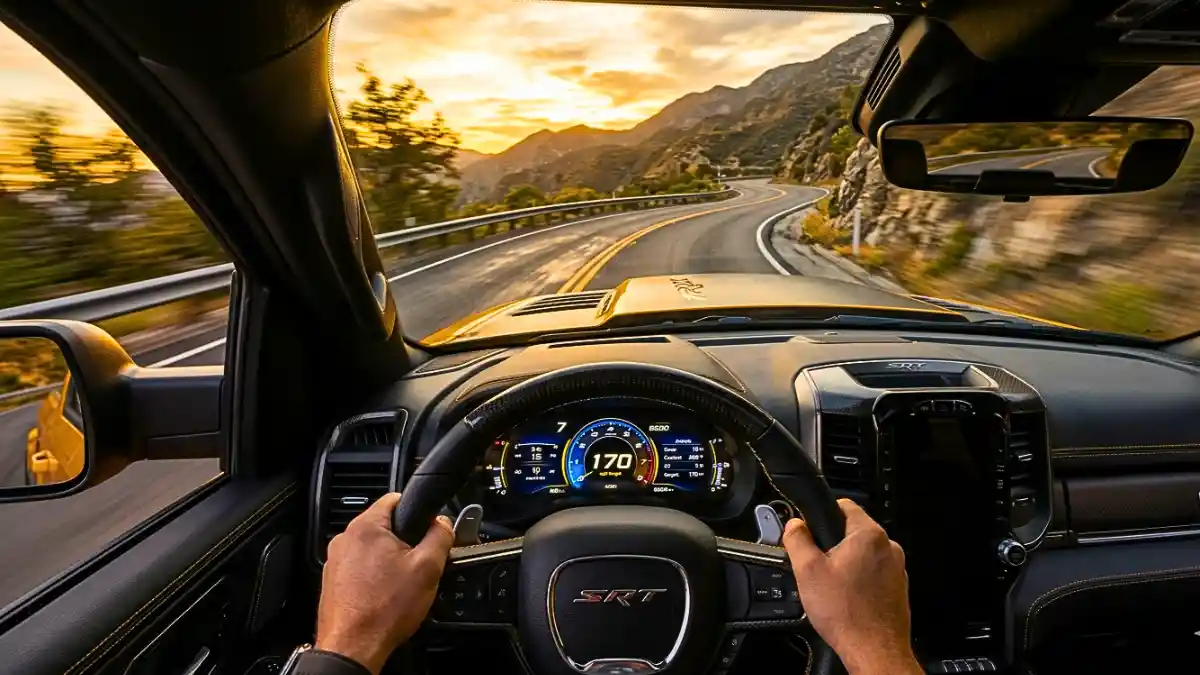
- Top Speed: 170 mph (Targeting world record)
- 0–60 mph: 3.4 s (In a 6,000-lb truck)
- Peak Power: 777 hp (Hellcat V8, SRT trim)
- Quarter Mile: 11.6 s (Supercar territory)
The truck market has spent the better part of a decade dressing itself in desert armor. Every launch cycle brings another variant of something with locking differentials, skid plates, and tires wide enough to cross a dry riverbed. They are remarkable machines. They are also, for most buyers who buy them, machines that never see a dirt road.
Ram has noticed. And rather than chase Ford’s Raptor deeper into off-road territory, Stellantis’ truck division has made a sharply different call: build something that goes very, very fast on pavement and makes no apologies for it.
The result is the Ram 1500 Rumble Bee, a street-focused performance pickup that borrows its soul entirely from the muscle car playbook, right down to how it feels behind the wheel. When Jay Leno recently drove an early example alongside Stellantis’ head of American brands, Tim Kuniskis, his instinctive observation told the whole story: close your eyes, and you’d think you were in a Dodge Challenger.
That is not an accident. It is the point.
An Old Idea, Resurrected with More Horsepower: The Ram 1500 Rumble Bee
Performance trucks aren’t a new invention. Ram itself made one of the most memorable examples ever built when it stuffed a Dodge Viper’s V10 engine into a pickup and called it the SRT-10. That truck held the title of the world’s fastest production pickup for years, topping out at 154.5 mph. It was absurd, impractical, and deeply beloved by people who understood what it was trying to say.
The Rumble Bee is a direct descendant of that philosophy. The entry-level model uses a 5.7-liter Hemi V8, the powerplant most buyers will actually choose, with a target price around $60,000. A mid-tier Apache trim brings a 6.4-liter V8. But the range-topping SRT version is the one that defines the vehicle’s ambitions: a 6.2-liter supercharged Hellcat V8, producing 777 horsepower and 680 lb-ft of torque, borrowed directly from the Ram 1500 TRX.
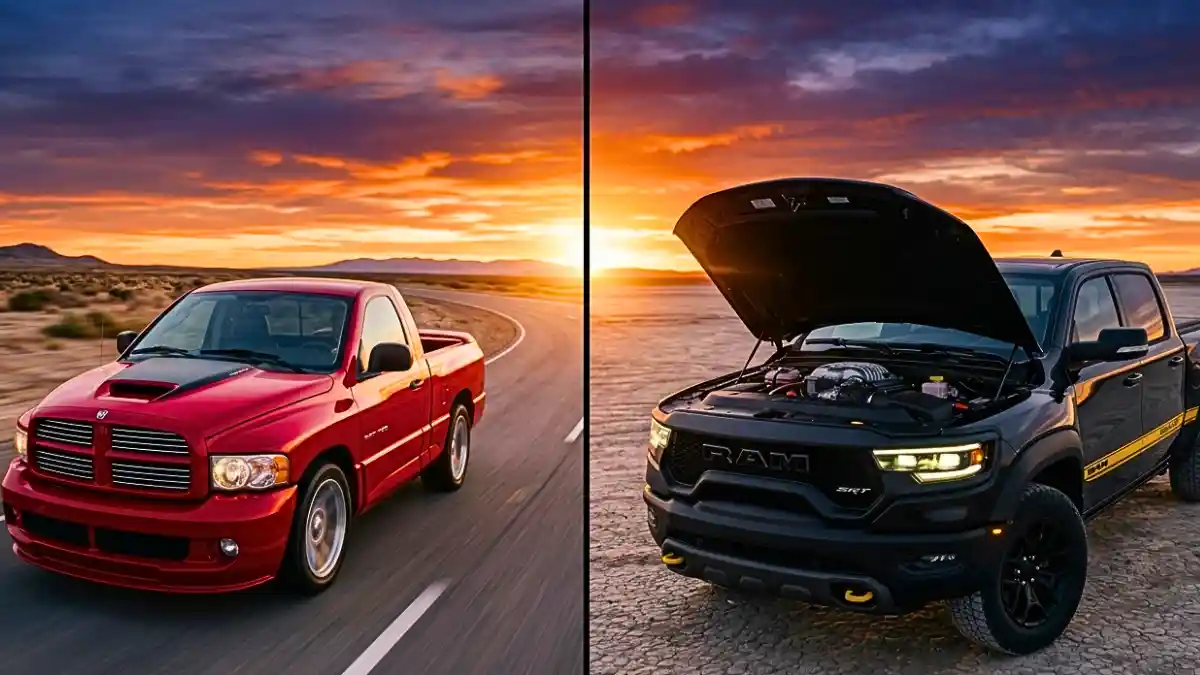
That powertrain, channelled through a truck that has been specifically tuned for road behaviour rather than rock-crawling, is what gets Ram to its 170-mph target, a figure that would finally retire the SRT-10’s standing record and re-establish the nameplate as the benchmark in a category most manufacturers had stopped caring about.
“For every person who buys a muscle car like the Dodge Charger, ten are expected to buy a muscle truck.” — Tim Kuniskis, Stellantis head of American brands
Also Read – Theon Design 964 Restomod: When Less Is the Fastest Thing on the Road
The Business Case Nobody Expected to Make for the Ram 1500 Rumble Bee
Kuniskis was disarmingly candid when he appeared on Jay Leno’s Garage to discuss the project. By Ram’s own internal data, he said, the company should not build this truck. The math, in conventional terms, does not work out cleanly.
And yet he made an argument that deserves to be taken seriously. Muscle cars have always been a small-volume category, a niche within a niche. But muscle trucks have a larger natural audience, because trucks are already America’s best-selling vehicle class by an enormous margin. If even a fraction of full-size truck buyers want something performance-oriented rather than off-road-oriented, the total addressable market is significantly larger, Kuniskis suggested, than the entire muscle car segment.
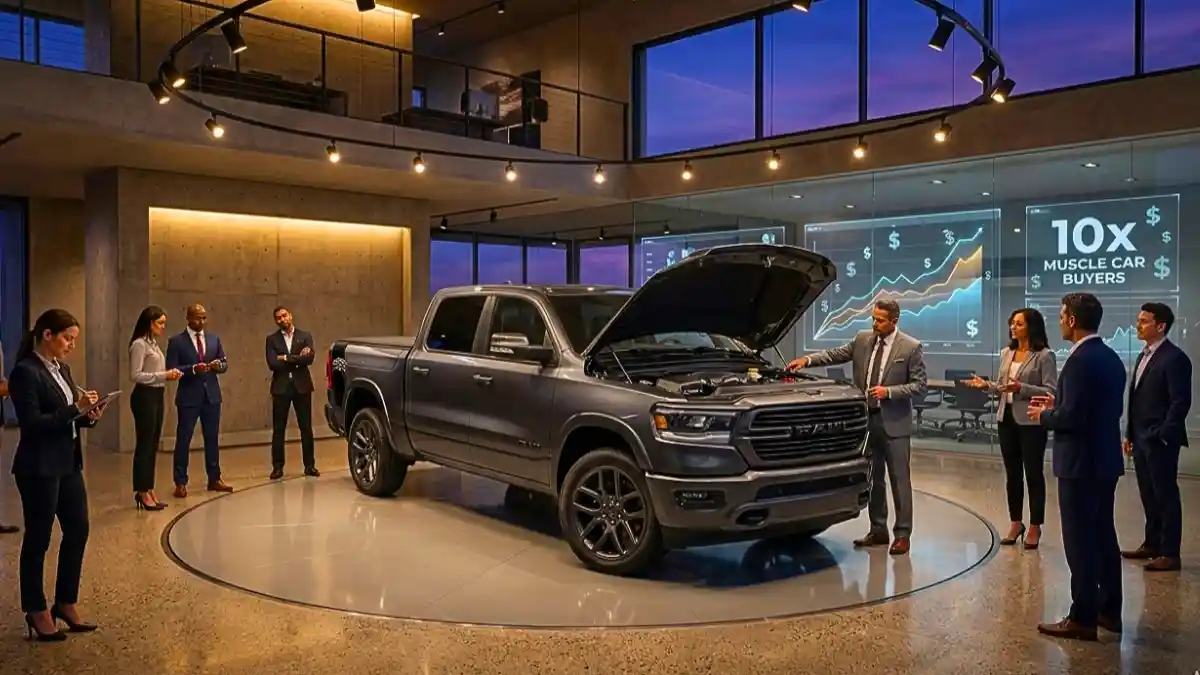
Whether that theory survives contact with actual consumers is the genuine question. But it is not an irrational bet. The Raptor has proven for years that premium, performance-oriented trim levels generate outsized profit margins and cultural cachet that filters down to the entire lineup. Ram is attempting the same trick, just pointed in a different direction.
Top speed comparison — production pickup trucks
- Ram 1500 Rumble Bee: 170 mph*
- Ram SRT-10 (2004): 154.5 mph
- Ram 1500 TRX: ~118 mph
- Ford F-150 Raptor R: ~112 mph
What Driving the Ram 1500 Rumble Bee Actually Feels Like
On Leno’s Garage, two trucks were on hand: the base Hemi model and the range-topping SRT. What struck Leno first was something mundane but meaningful for daily usability: the ride height. Air suspension allows the Rumble Bee to sit lower than a typical full-size truck, making it dramatically easier to get in and out of something that has become a genuine complaint about modern pickups, which have grown tall enough that some buyers effectively need a step stool.
On the road, Leno noted the steering feel was virtually identical to the Challenger’s- direct, communicative, not the vague, disconnected experience common in trucks. The ride was comfortable. The overall impression was of a vehicle that had been tuned around the driver’s experience on actual roads, not around approach angles and water-crossing depth.
Leno also asked the inevitable question: could it come with a manual transmission? Kuniskis’ answer was straightforward. Ram could engineer one, but demand simply isn’t there. It is the honest, if slightly dispiriting, answer that almost every performance brand has given over the past decade. The era of the manual muscle truck has passed, and it is not coming back.
Also Read – Ford’s $30000 Electric Pickup Reboot: Not the Sequel You Think It Is
What the Ram 1500 Rumble Bee Signals for the Truck Market
The Rumble Bee’s arrival matters beyond its own specifications. It is a direct statement that the performance truck category can be divided, that “performance” does not automatically mean off-road, and that there is a meaningful audience for a truck that rewards the driver specifically for driving it hard on public roads.
Pricing will ultimately determine whether the concept lands. A $60,000 entry point for the Hemi version is competitive, though the SRT model will almost certainly climb well past $80,000 once options and the Hellcat tax are factored in. At those prices, Ram needs buyers to feel they are getting something meaningfully different from a Hellcat Challenger, and arguably, given the practicality of a truck bed and cab configuration, they are.
The quarter-mile figure of 11.6 seconds is the one that will circulate on enthusiast forums. For context, that time puts the Rumble Bee in the same conversation as dedicated sports cars. Achieving it in a vehicle that weighs three tons is the kind of engineering statement that needs no translation.
Whether the world is ready for Ram’s muscle truck revival remains genuinely uncertain. Kuniskis himself admitted as much. But the data he cited, ten potential muscle truck buyers for every muscle car buyer, suggests that if this bet does pay off, it could pay off in a way that nobody in Detroit has properly captured since the original SRT-10 rolled off the line in Saltillo, Mexico, two decades ago.
Sometimes the best business decisions are the ones nobody thought should be made.
Also Read – Rivian R2 Mainstream Survival Gamble: The Test That Will Make or Break the Brand


Raj is the creative mind curating the special content for the website. From exclusive first-drive reviews to buyer’s guides and comparison tests, Raj ensures our features are engaging and helpful. He loves getting behind the wheel of new launches and creating content that helps our readers pick their dream vehicle. His passion for motorcycles and performance cars is evident in his energetic writing style.