There’s a particular kind of corporate promise that sounds bold until you look at the factory floor. When a carmaker announces a deadline to go all-electric, it’s often a distant ambition, padded with caveats and exit ramps. The assembly lines keep churning out pistons and fuel injectors, engineers still refine turbocharger responses, and the accountants quietly pencil in a decade of gasoline-powered profits. Most automakers are juggling two realities: the electric future they talk about and the combustion present they depend on. Volvo burnt combustion engine blueprint entirely, and that changes everything.
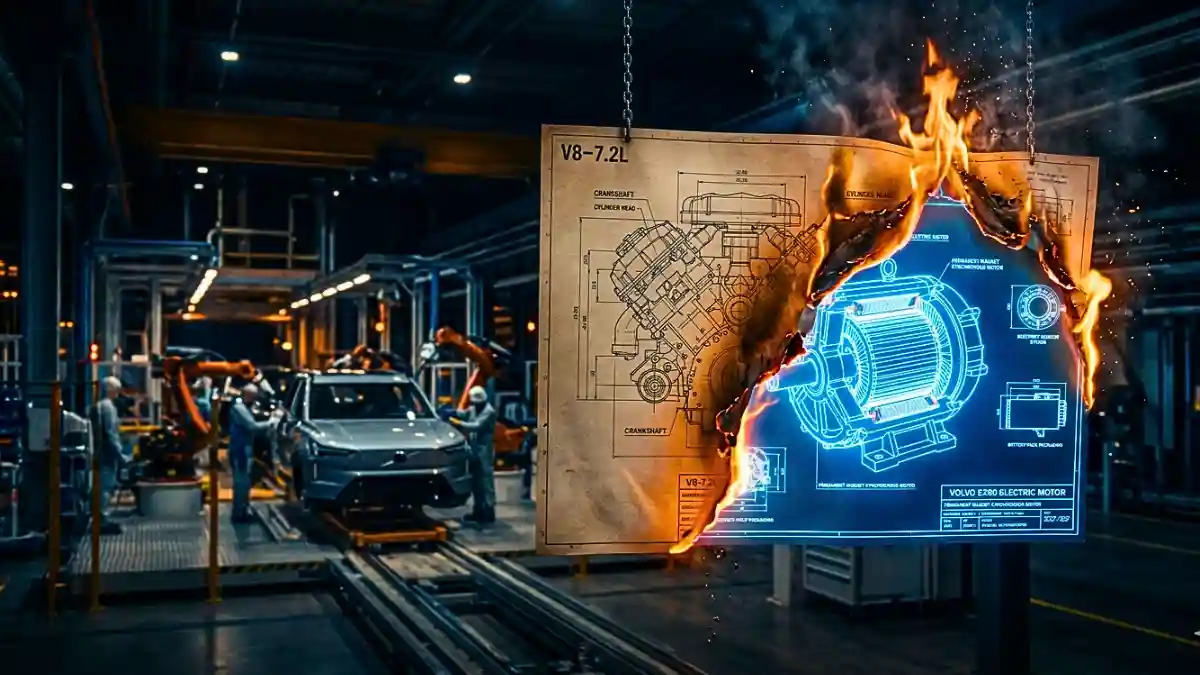
Volvo just drew a much sharper line. The Swedish brand, now under Chinese ownership, hasn’t simply set a 2030 target for full electrification — it has systematically dismantled the industrial backbone of its internal combustion era. In a revelation that redefines how serious a legacy car company can be about the energy transition, Volvo’s chief engineering and technology officer, Anders Bell, confirmed the company no longer owns or operates a single factory dedicated to building combustion engines. Those plants have been either sold off or repurposed to produce electric motors.
This isn’t a PR pivot. It’s a structural severance. And it changes the narrative around what an established automaker can actually commit to when the world’s appetite for EVs looks shakier than it did two years ago.
Why Volvo Burnt Combustion Engine Blueprint Matters More Than a Sales Target
Automotive history is littered with bold electrification pledges. What makes Volvo’s move distinct is that it addresses supply, not just demand. A company that no longer manufactures its own engines has surrendered the core competency that defined carmakers for a century. The internal combustion engine wasn’t just a component; it was a car company’s identity, its intellectual property fortress, and often its primary source of profit through scale, service, and parts.
By exiting engine manufacturing entirely — even as it still sells mild hybrids and plug-in hybrids that require a gasoline heart — Volvo is choosing to become a systems integrator for the dying technology rather than its custodian. Bell said combustion engines are “not part of our core technology anymore,” and that Volvo will lean on outside partners for any future combustion engine needs rather than restart internal development programs. In plain terms, Volvo has decided the ICE age is over, and the company would rather rent a room in it than own the house.
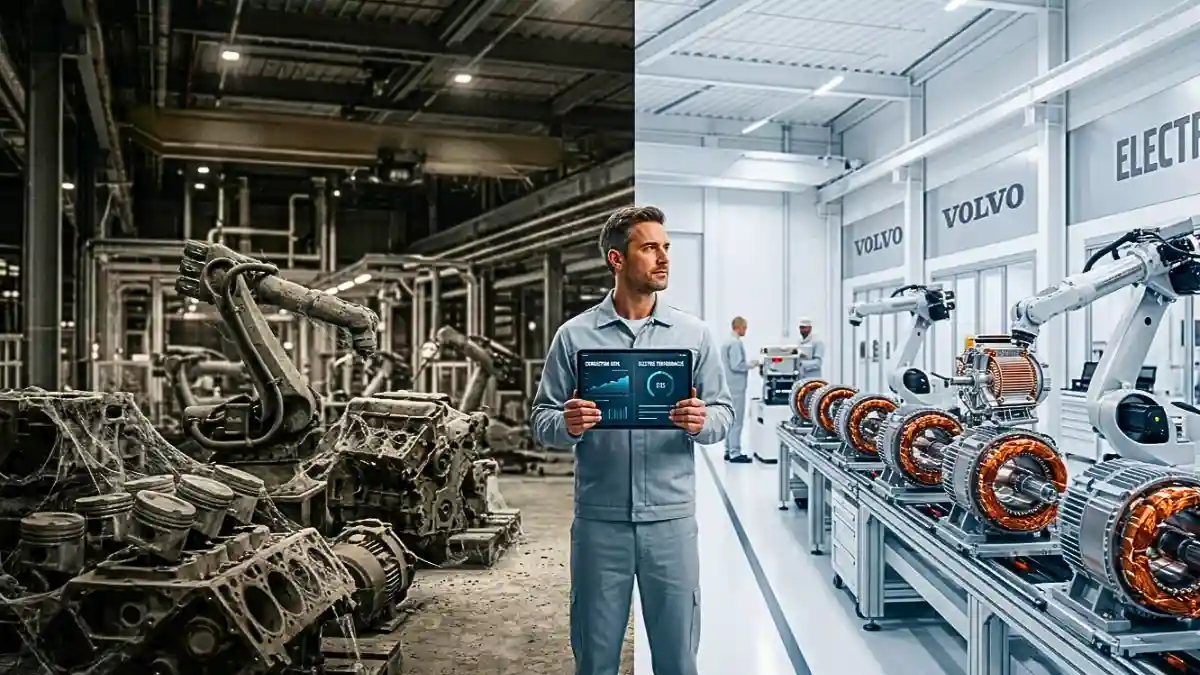
This is the kind of decision that separates genuine transformation from carefully hedged transition rhetoric. When a carmaker sells an engine plant, it’s shedding fixed costs, yes, but it’s also permanently altering its institutional muscle memory. The engineers who used to obsess over cam profiles and cylinder deactivation are either gone or retrained on rotor lamination and stator winding. That knowledge transfer is expensive and irreversible. You can’t easily reverse-engineer a lost industrial culture.
Also Read – The Big Truck Mirage: Why GM Is Walking Away From Its Heaviest Silverados — and What Comes Next
The Quiet Decoupling
What’s particularly striking is the timing. Volvo’s confession of a post-combustion manufacturing reality comes as several European peers push back hard against the EU’s planned 2035 de facto ban on new combustion engine cars. Slowing EV adoption growth, anxiety over charging infrastructure, and fierce Chinese competition have prompted calls for softer targets and more “technology neutral” pathways. The industry’s unity on an electric future is fraying. Even stalwarts like Mercedes-Benz and Volkswagen have tempered their tone, emphasizing flexibility.
Volvo, however, appears to be moving in the opposite direction — not by shouting louder about deadlines, but by quietly hollowing out its own fossil-fuel apparatus. The company still sells the gas-powered XC90 and XC60 alongside its electric EX90 and EX30. It knows American families who tow boats and road-trip across Montana still overwhelmingly choose internal combustion. But instead of keeping those engine plants humming as an insurance policy, Volvo seems to be betting that the hybrids it will offer in the near term can use power units sourced from third parties — akin to how a smartphone manufacturer buys chips — while its in-house engineering talent focuses entirely on the electric architecture that will underpin everything from compact SUVs to flagship sedans.
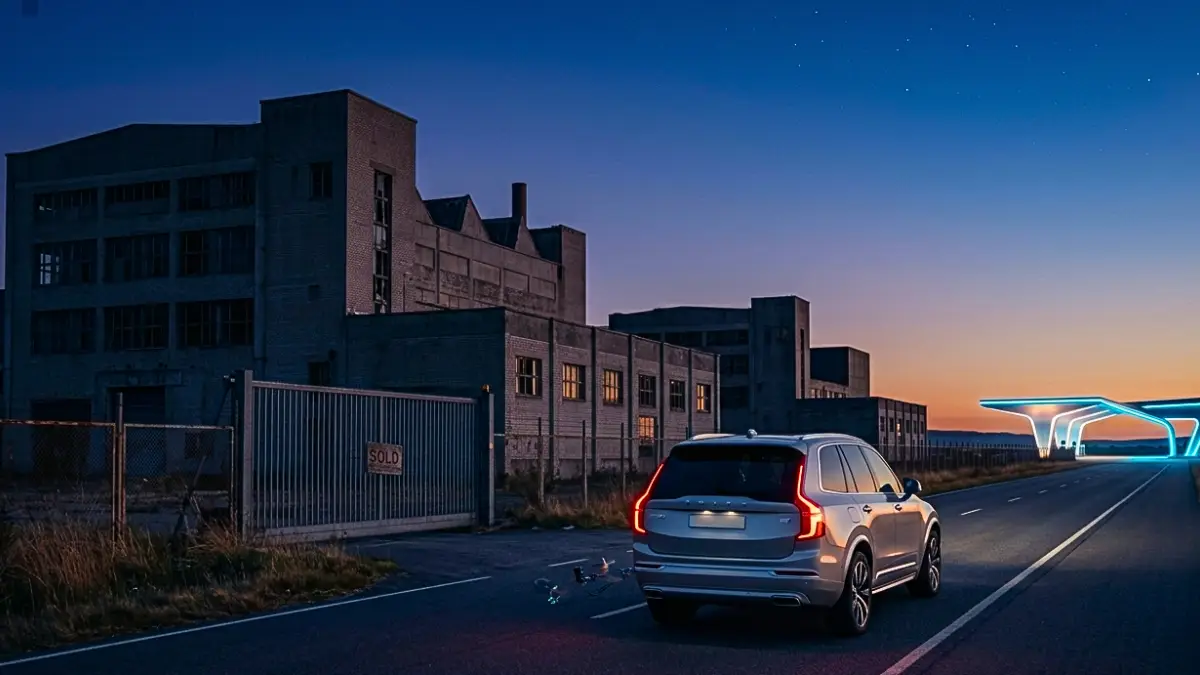
This isn’t just a manufacturing reshuffle; it’s a strategic bet that the future of competitive advantage in the car industry lies in software, batteries, and electric motor efficiency, not incremental improvements to a technology destined for regulatory extinction. It also hints at a deeper confidence: Volvo thinks the market’s current hesitation is noise, not signal. Bell explicitly pointed to Norway, where fully electric vehicles now account for about 96% of new-car sales, as evidence that when the ecosystem is ready, consumers switch fast and don’t look back.
The Real Story Is Under the Hood of the EX30
Volvo’s factory exodus also makes sense through the lens of its product pipeline. The EX30, a compact electric crossover developed on a Geely platform and initially built in China, is precisely the kind of vehicle that traditionalists would struggle to match because their cost structures are still weighed down by engine plants and the complexity of multi-powertrain platforms. Volvo leadership has even signaled openness to building Chinese-developed, affordable EVs in the United States if trade conditions allow — a move that would have been unimaginable a decade ago when “Swedish engineering” was inseparable from the sound of a turbocharged five-cylinder.
By sloughing off its engine manufacturing arm, Volvo can accelerate that kind of agility. It doesn’t have to protect legacy assets that become stranded faster than depreciation schedules can handle. Electric motors are simpler devices; they don’t need the same cathedral-like factories with hundreds of machining stations honing blocks to micron tolerances. That means Volvo can pivot its manufacturing footprint more nimbly, chase where labor and battery supply chains are cheapest, and avoid the internal political battles that paralyze companies trying to feed both the old and new businesses simultaneously.
The risk, of course, is non-trivial. If the global north’s charging build-out stalls, if battery mineral costs spike again, or if a political backlash against EV mandates leads to a prolonged period where combustion vehicles retain a significant market share beyond 2035, Volvo could find itself over a barrel, buying engines from rivals or suppliers at a disadvantageous price. But the company seems to have calculated that the technical know-how for making a competent gasoline engine is now so commoditized — and the incremental gains so marginal — that there’s no strategic value in holding onto it. That’s a controversial view in Stuttgart and Munich, but increasingly unremarkable in Hangzhou and Shanghai, where Volvo’s parent Geely sits.
Also Read – Build Your Dream Rivian R2: The Configurator Is Finally Live – Here’s What You Need to Know
What This Means for the Industry’s Transition
Volvo’s move will likely be scrutinized as either a trailblazing masterstroke or a costly overcorrection. For suppliers, it sends a clear signal: the future order books won’t include high-pressure fuel pumps and complex exhaust after-treatment systems from those plants. For workers and communities dependent on engine manufacturing, it’s a harsh preview of the just-transition challenges that policymakers have been skirting.
More broadly, the news tests a provocative thesis: that legacy automakers don’t need to manage a graceful dual-powertrain world for another decade; they need to amputate the combustion business before it drains resources and attention from where the growth actually lies. The conventional wisdom says you need hybrid profits to fund the EV future. Volvo is effectively arguing that the profit pool from hybrids isn’t worth the distraction of maintaining in-house engine expertise. It’s a lean startup logic applied to an 97-year-old industrial firm — and it might just work, or it might leave the company dangerously exposed if the market zigs when Volvo has already zagged.
For now, the factory floor tells a story no press release can match. You don’t sell the engine plant if you’re keeping your options open. You don’t convert it to build electric drive units unless you believe the electric horse has not only left the barn but is already winning races. Volvo’s 2030 goal looks less like aspirational marketing and more like a logistical roadmap — because the people and machines needed to deviate from it are no longer on the payroll. In an industry that loves to announce revolutions while clinging to evolutions, that’s about as close to a point of no return as you can get.
Also Read – 2028 BMW 1 Series Rear-Wheel Drive: How Electrification Returns the Hatch to Its Roots

If it runs on electricity or has a microchip, Rahul is on it. As our resident tech geek and electric vehicle (EV) specialist, Rahul decodes complex technologies into simple language for our readers. He stays ahead of the curve on battery technology, autonomous driving, and the latest digital trends in the automotive sector. If you want to know the real range of an EV or the future of mobility, Rahul has the answers.