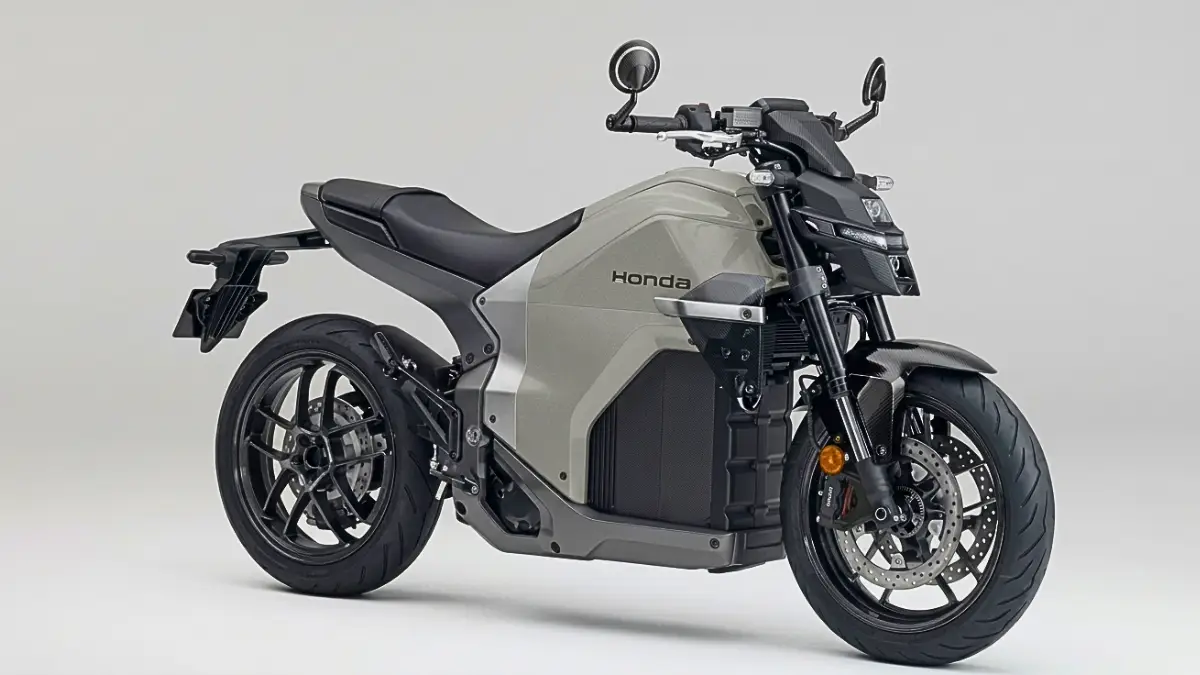
The electric motorcycle should be a triumph of engineering. It promises instant torque, silent propulsion, and a powertrain with barely a dozen moving parts. And yet, for the very riders who should be celebrating this, the machine often feels like a stranger. Honda’s latest patent, a Honda fake clutch electric motorcycle system of synthetic clutch feel, simulated gear shifts, and artificial engine vibrations—is not a quirky piece of laboratory whimsy. It is a quiet admission that the biggest obstacle to electrifying two wheels is not range or charging time. It is the soul.
The Missing Vocabulary
Riding a motorcycle with a manual transmission is a conversation. The clutch lever is the first word. The friction zone, that narrow band where the plates begin to kiss, is the dialect you learn over years. A seasoned rider doesn’t think about slipping the clutch to modulate speed through a tightening corner; the left hand does it on its own, a sub-routine burned into the cerebellum. The right foot selects gears based on a sensed marriage of engine note and road speed. Even the vibrations travelling up through the footpegs and tank are carrying data—about engine load, about traction, about when to shift.
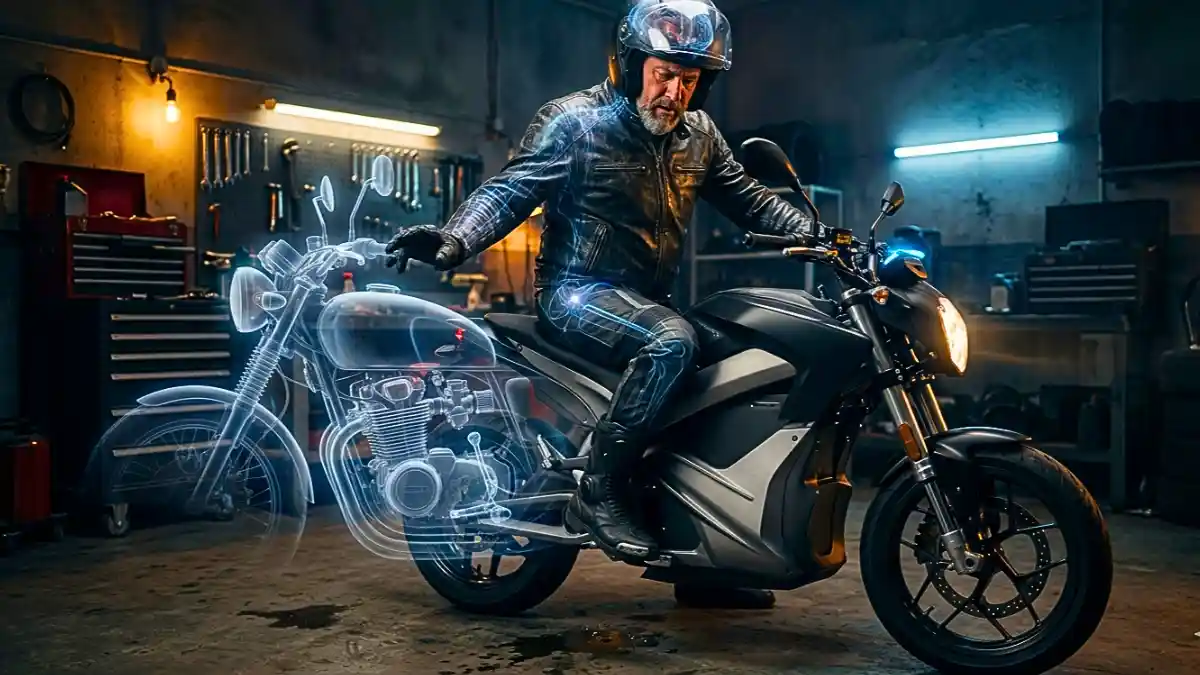
Electric motorcycles erase that entire sensory vocabulary. Twist the throttle and you get silent, seamless, relentless shove. It is objectively efficient. It is also, for a rider with decades of muscle memory, profoundly disorienting. You reach for a gear lever that isn’t there. The bike never “settles” into a steady-state vibration at cruising speed. In a slow U-turn, where a petrol bike’s flywheel inertia and clutch drag act as a natural stabiliser, the electric machine can feel nervously binary—on or off, no gentle middle ground. Honda’s patent, filed with the Japan Patent Office, is a blueprint for returning what has been lost. Not through mechanical necessity, but through deliberate artifice.
Engineering an Illusion: Inside the Honda Fake Clutch Electric Motorcycle System
What Honda is proposing is remarkably literal. The “pseudo-clutch” isn’t a button that pretends to shift gears. It’s a fully articulated lever on the left handlebar, wired to a system that simulates the progressive resistance, engagement point, and slip feel of a real multi-plate clutch pack. As you release the lever and roll on the throttle, actuators generate a counterforce that mimics the spring pressure of a clutch diaphragm, and the motor controller briefly modulates torque to replicate that fleeting moment of slip before full lock-up. The rider’s brain receives the same haptic telegram: “You are in control of the connection between motor and wheel.”
Similarly, the patent describes a dedicated artificial flywheel—a small, motor-driven rotating mass that spins up in concert with the virtual “engine revs”. This generates gyroscopic and inertial effects. On a conventional bike, the crankshaft, generator rotor, and flywheel resist changes in direction; they contribute to a bike’s willingness to stay upright and to the deliberate, pendular roll into a corner. Honda’s system recreates this sense of a living, spinning heart inside the chassis, rather than a silent, inert block of battery cells.
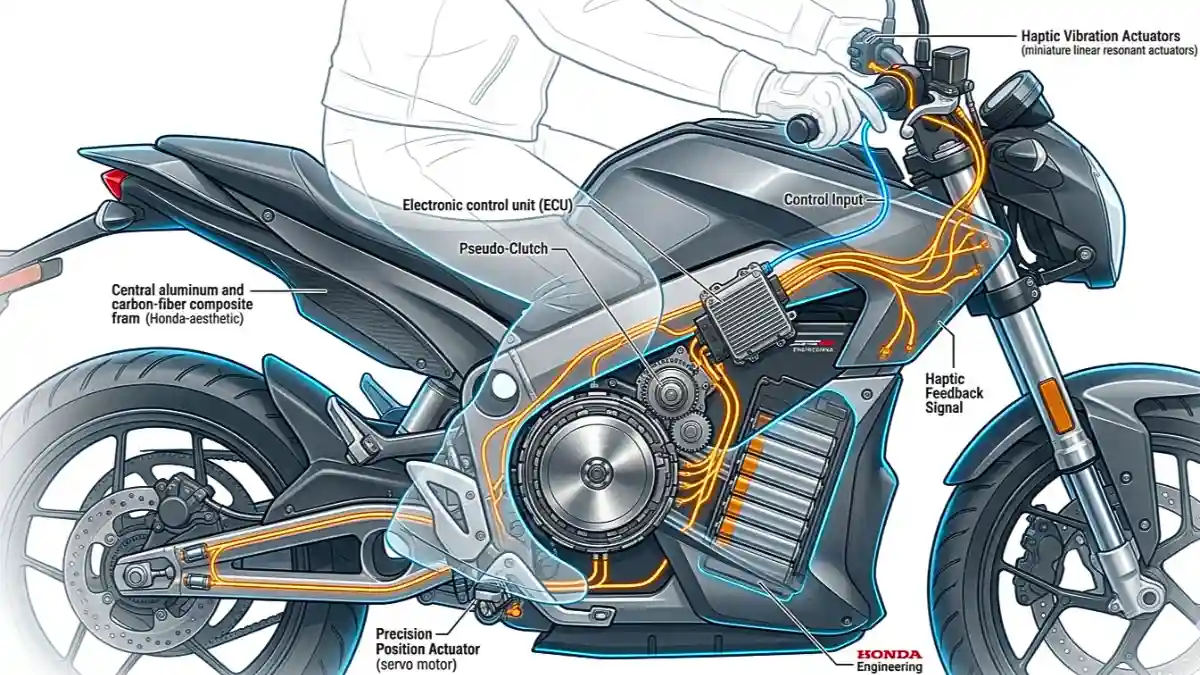
Then there is vibration. An internal combustion engine, particularly a twin, is a controlled tremor. At idle, the bars buzz a low-frequency tattoo. Under load, the footpegs hum a different note. These are not distractions; they are part of the rider’s feedback loop, signalling how hard the engine is working. Honda plans to weave this back into the experience using voice-coil actuators, similar to those that make your smartphone vibrate but scaled up, and tuned to the frequency signatures of specific engine configurations. If you want your electric bike to feel like a 270-degree parallel twin, a flat-six, or a single-cylinder thumper, the system can oblige—without a single explosion taking place.
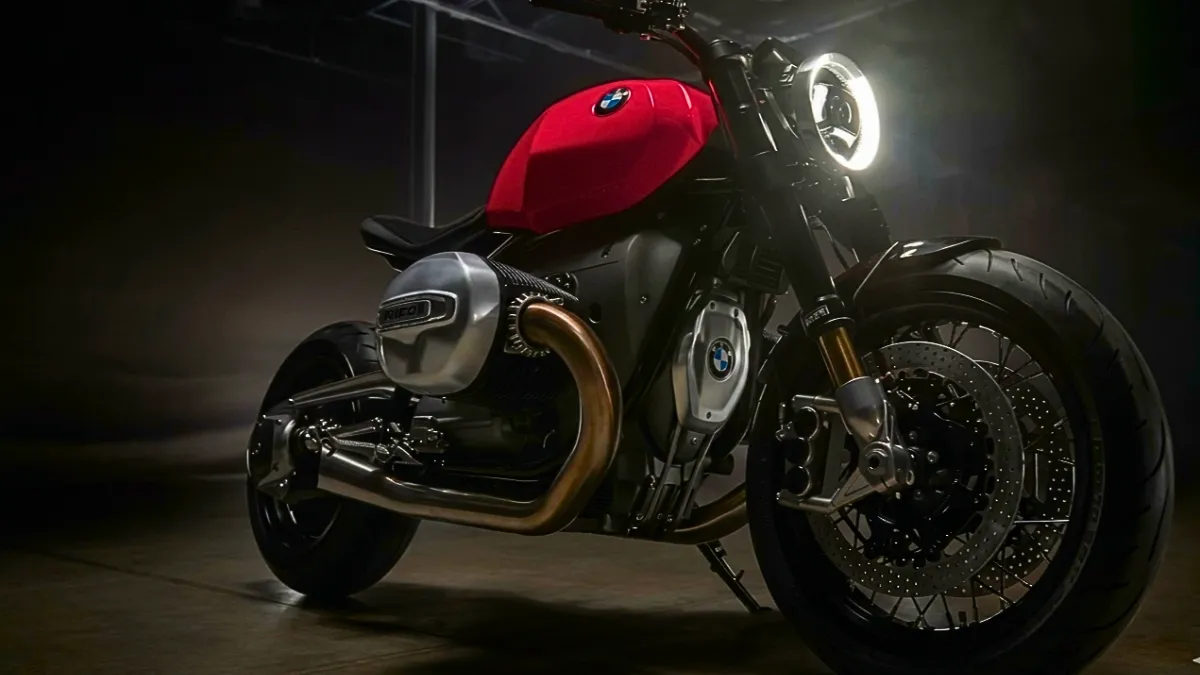
Also Read – BMW R20 Production-Ready: Near-Production Form Spotted — 2000cc Boxer Beast Drops Camo, Looks Ready to Roar
Why This Isn’t Just Nostalgia
It would be easy to dismiss this as a gimmick for retirees who miss their carburettors. That misses the point. The target audience is not the complete novice, who might embrace an electric twist-and-go scooter with open arms. It is the vast population of experienced motorcyclists who learned on and still ride manual machines—the people Honda sells its CB series, Hornets, and H’ness CB350s to by the tens of thousands. In markets like India, Southeast Asia, and Southern Europe, the manual motorcycle remains not just a vehicle but a rite of passage and a daily skill. Convincing these riders to switch to electric is not simply a question of price parity or charging infrastructure. It’s about identity. Tell a rider that their clutch hand is now redundant, and you are telling them a part of their competence no longer matters.
Honda understands this deeply. The company’s history is built on making intuitive human-machine interfaces—from the step-through Cub to the seamless dual-clutch gearboxes on its Gold Wings. This patent suggests they see the sensory void of electric motorcycles as a core design problem, not an afterthought. It’s a strategic move to lower the psychological barrier to adoption. A rider who can get on an electric bike and immediately feel the familiar pulse, the tactile engagement point, and the rhythm of shifting is a rider who might actually consider buying one. Without that, an electric motorcycle is an appliance. With it, it becomes a continuation of a lifelong passion.
Of course, a patent filing is not a product announcement. Car and bike makers patent countless ideas that never see a showroom floor. But the level of detail here—the separate mechanical flywheel, the nuanced clutch-slip simulation—points to serious prototyping, not just blue-sky brainstorming. It joins a small but growing chorus of attempts to re-engineer engagement. Kawasaki has shown electric concepts with a physical gear lever. Several boutique EV brands have offered simplified clutch-like controls. Honda’s heavyweight entry into this space signals that the industry’s biggest players are taking the emotional resistance of their customers seriously enough to protect the intellectual property.
Also Read – TVS FY26 Sales Record: 5.9 Million Units Moved – Here’s How They Pulled It Off
The Future of Feeling
The implications run beyond motorcycles. As mobility becomes electrified, the question of sensory feedback is becoming central. Car makers pipe synthesised engine sounds into cabins. Racing simulators use force-feedback steering wheels and haptic pedals. What Honda is proposing for bikes is a logical next step: the first truly high-fidelity, multi-channel simulation of an internal combustion experience on an electric platform, integrated from the factory by an OEM. If they pull it off, it could set a new bar for what an “authentic” ride feels like in a carbon-neutral age.
There is also a deeper, more philosophical door this opens. Once you decouple the feel of a machine from its physical powertrain, the experience becomes a software-defined canvas. A single motorcycle could, in theory, be reconfigured to feel like a thumping single-cylinder on Monday, a raucous inline-four on Saturday, and a serene electric glide for the weekday commute. The very notion of brand character—the mechanical fingerprint that distinguishes a Ducati from a Honda—might one day become a downloadable setting.
For now, though, the message is simpler. Honda is telling millions of clutch-handed, vibration-reading, downshift-blip-ping riders: “We see you. You are not being left behind.” It’s a reminder that the most sophisticated technology isn’t always the one that removes effort, but the one that preserves meaning. And on a motorcycle, meaning often lives in the pulse between your fingers.

Sapna is the storytelling powerhouse of the team. With a sharp eye for detail and a knack for uncovering the human interest side of automobiles, she covers everything from industry launches to feature stories. She believes that every car has a story and every rider has a journey. Her writing is known for its clarity, depth, and ability to connect with the common man.