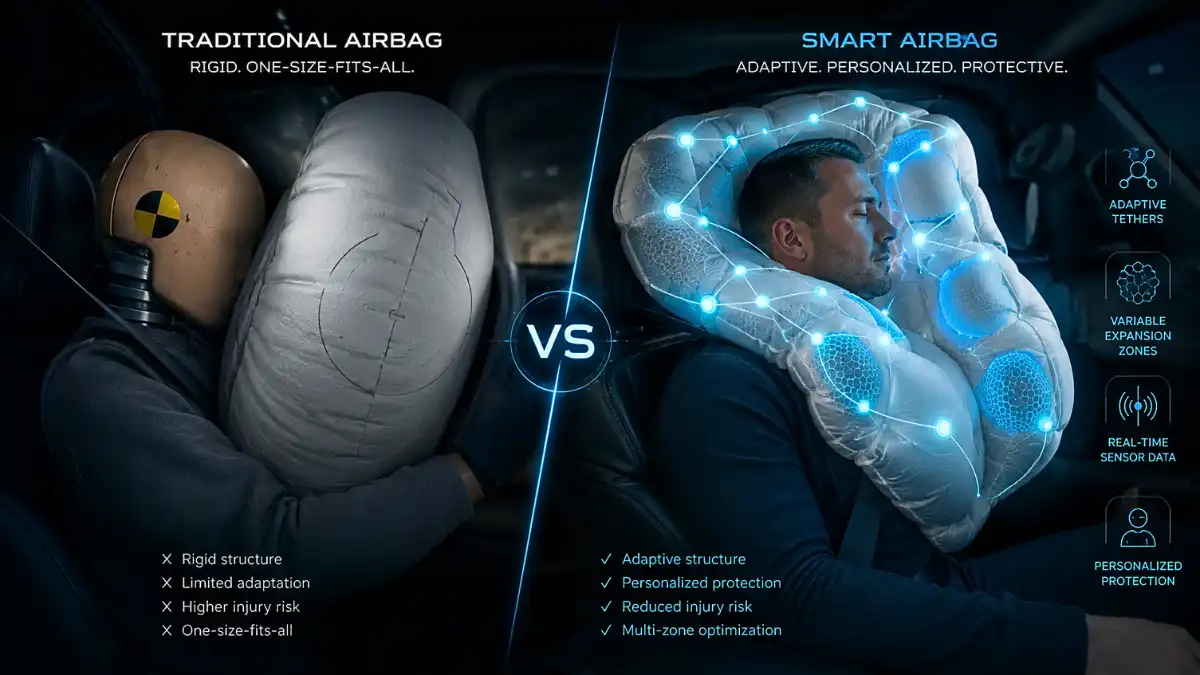
GM’s new GM variable deployment airbag patent hints at a safety revolution long overdue: airbags designed not for a crash dummy, but for an actual person.
- 50+ yrs: Airbags in production
- #12637026: GM USPTO patent
- Variable: Deployment design
Somewhere in the history of automotive engineering, a decision was made: one airbag size fits all. It was a reasonable compromise for the era; computing power was limited, sensors were crude, and a blunt instrument that stopped heads from hitting dashboards was a genuine lifesaver. That calculus hasn’t changed much since. Airbags still deploy with the same logic whether the person in front of them is a six-foot-two adult male or a ninety-pound teenager.
General Motors wants to rethink that assumption from the ground up. A patent published last week describes a system where airbag deployment isn’t a fixed, predetermined blast but a dynamic response shaped in real time by who is sitting in the seat and how they’re sitting in it.
The Problem With Designing Safety for the Average Person
The automotive safety world has long understood that “average” is a statistical fiction. The original crash test dummy was modelled on a 50th-percentile American male, a choice that systematically undertested protection for women, children, and anyone outside that narrow demographic. It took decades and significant regulatory pressure for that to begin to change.
Airbags carry some of this same legacy bias. Their inflation speed, direction, and pressure are calibrated for upright, belted occupants of a certain size. In real crashes, people are rarely in the ideal position; they’re leaning into a turn, tilted toward a phone, reclined in a semi-autonomous vehicle, or simply built differently than the engineers anticipated.
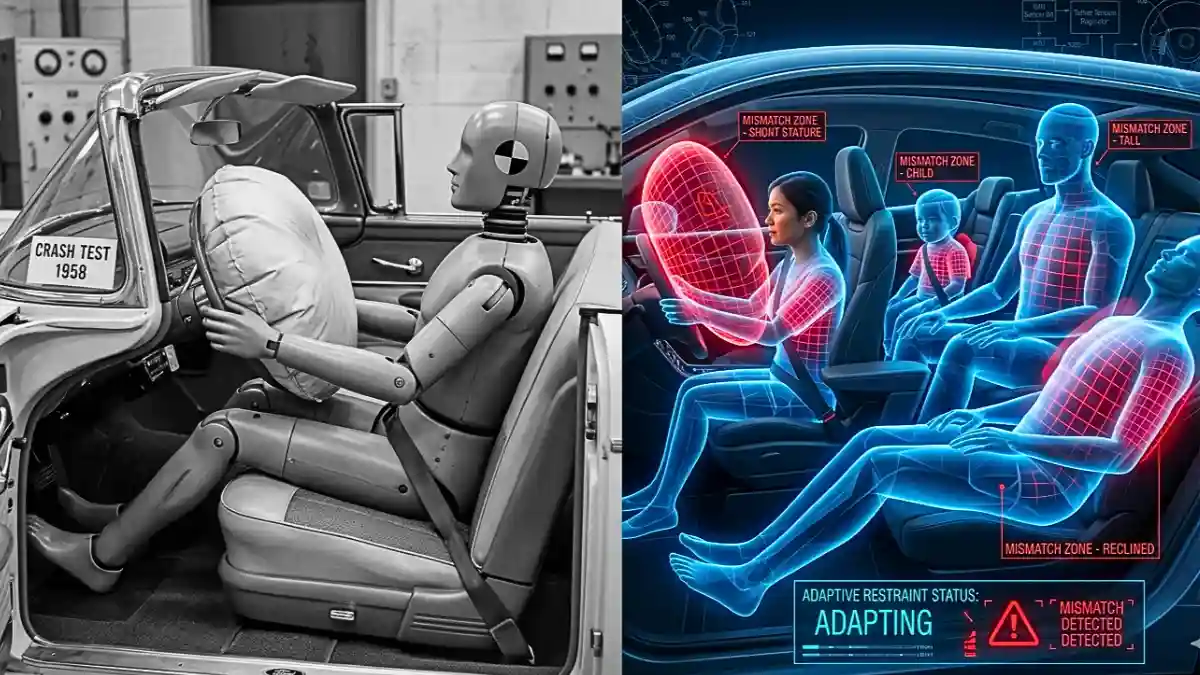
This gap between designed-for and built-for has real consequences. Shorter occupants sitting close to the steering wheel face a disproportionate risk of airbag-induced injury. Children in improperly positioned seats can be harmed by the very system meant to protect them. The Takata inflator scandal, which led to the largest automotive recall in U.S. history and is still producing fatalities years later, was a failure of hardware, but the underlying vulnerability it exposed was always about the relationship between the passenger and the airbag.
Also Read – Hyundai Phantom Braking Recall 2026: When Safety Systems Become the Threat
What GM Variable Deployment Airbag Patent Is Actually Proposing
The patent, formally titled “Vehicle Airbag System With Variable Deployment”, isn’t describing a marginal improvement. It proposes rethinking the airbag as an adaptive structure rather than a static cushion.
The technical core of the idea involves adjustable tethers and internal restraints that control how the airbag expands, not just how fast, but in which direction, to what volume, and with what degree of firmness. Patent drawings show configurations where the bag partially wraps around a passenger or works in coordination with the seat, roof liner, or door panel to create a more contained protective zone rather than a single frontal explosion of fabric and gas.
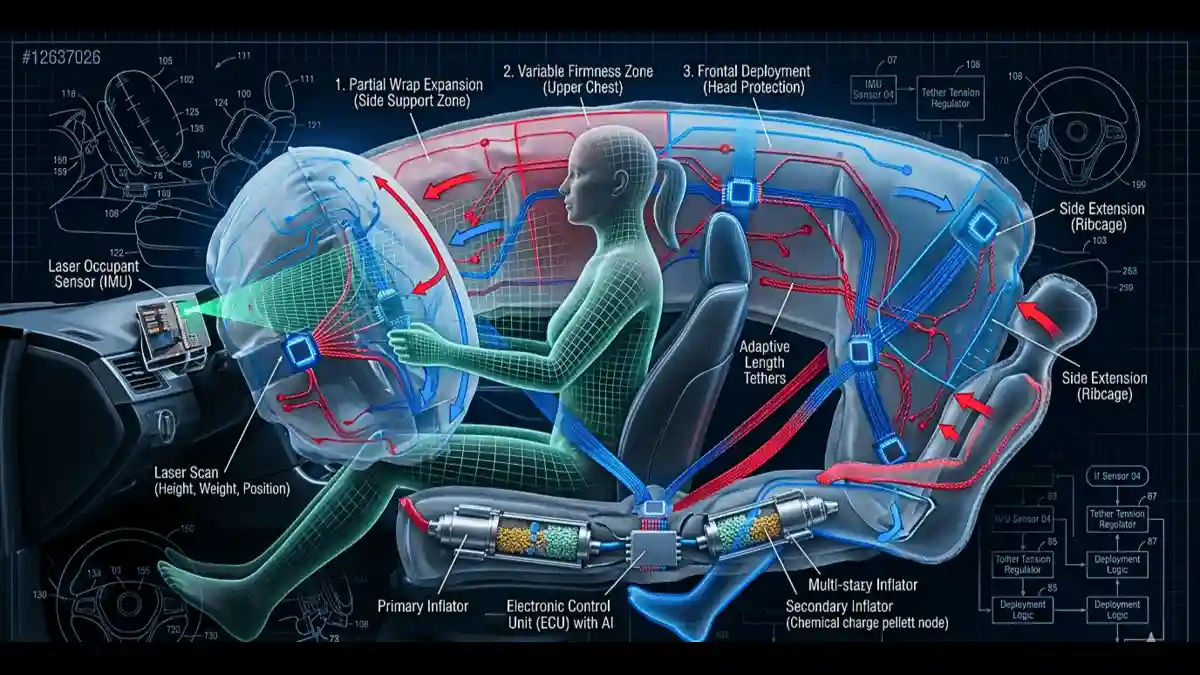
The system would draw on sensor data about occupant position, whether someone is sitting upright or leaning back, close to the wheel or pushed away from it. The implied architecture is one where each deployment event is, in a sense, computed rather than mechanical: the airbag responds to the person, not just to the crash.
A Wider Trend the Industry Can’t Ignore
GM is not the only manufacturer thinking this way. Toyota has been exploring adaptive restraint geometry for years, working from a similar premise: that the body geometry of a vehicle’s occupants is too variable to address with a one-size solution. Chinese automakers producing premium vehicles with ultra-reclined rear seats have been grappling with a more acute version of the problem. Regulators in multiple markets have raised concerns that extreme recline positions put passengers outside the protective envelope of current airbag systems.
Autonomous and semi-autonomous vehicles have sharpened the urgency. When passengers routinely travel reclined, facing sideways, or in entirely novel seating configurations, the entire passive safety architecture built around the conventional forward-facing position starts to look fragile. The airbag problem and the autonomy problem are, increasingly, the same problem.
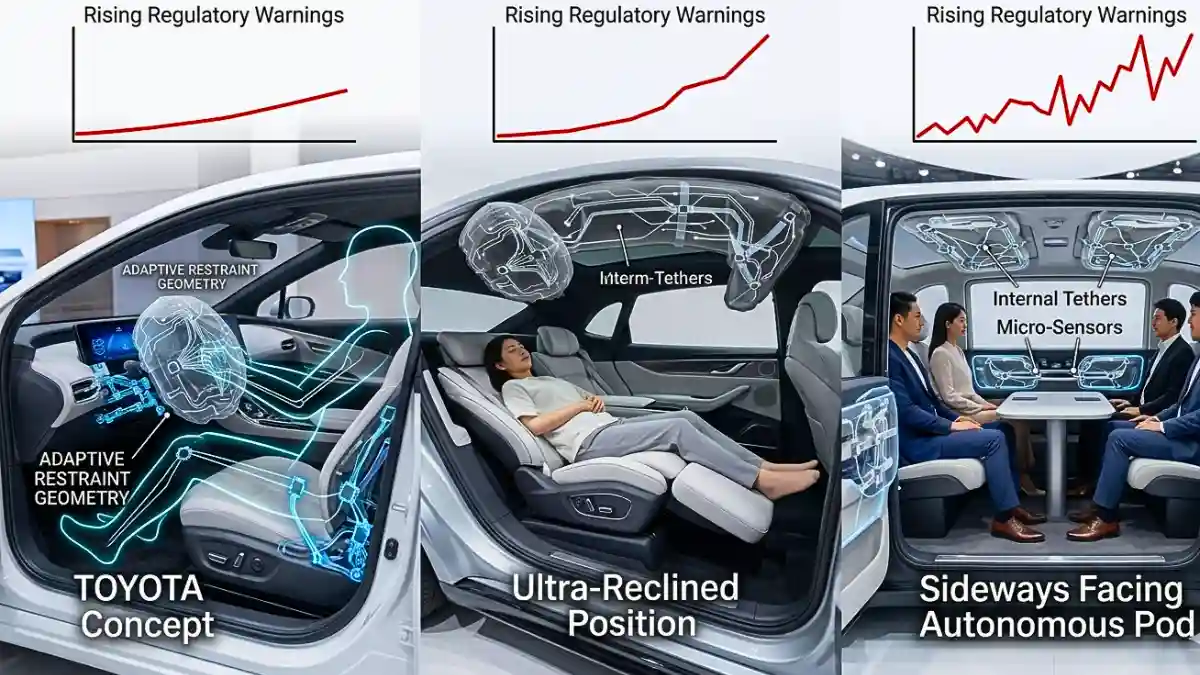
What GM’s patent represents is a systems-level answer to that challenge, an attempt to build adaptability into the restraint itself, rather than hoping passengers will always cooperate with the assumptions baked into 1970s-era design philosophy.
Also Read – Dodge Copperhead SRT Coupe Returns to Lead a Bold New SRT Army
The Long Road From Patent to Production
Patents are speculative by nature. They represent a manufacturer’s vision of what could be built, not a commitment to build it, and the automotive industry is full of technology that moved from drawing board to production only after years of engineering, regulatory negotiation, supplier development, and cost modelling.
Adaptive airbag systems introduce real complexity. The software and sensor stack required to classify occupant position accurately enough to inform deployment decisions adds failure modes that must be exhaustively tested. Regulators will need to evaluate not just whether the system works in optimal conditions, but what happens when it misreads a passenger and what liability framework governs that failure.

That said, dismissing this as a patent-shelf curiosity would be a mistake. The direction of travel in vehicle safety is clearly toward personalisation, toward restraint systems that know something about who they’re protecting. Occupant detection technology has matured considerably. The computational cost of real-time sensor processing has collapsed. The regulatory pressure from autonomous vehicle configurations is only going to intensify.
GM’s patent may not be the specific implementation that reaches a showroom floor. But it’s pointing at a problem that the industry will have to solve and documenting one serious engineering approach to solving it.
Also Read – 2027 Dodge Durango V-8 SUV: The Last Roar – Why Dodge Is Selling a 710-HP Family Hauler in a $4-Gallon World

Raj is the creative mind curating the special content for the website. From exclusive first-drive reviews to buyer’s guides and comparison tests, Raj ensures our features are engaging and helpful. He loves getting behind the wheel of new launches and creating content that helps our readers pick their dream vehicle. His passion for motorcycles and performance cars is evident in his energetic writing style.