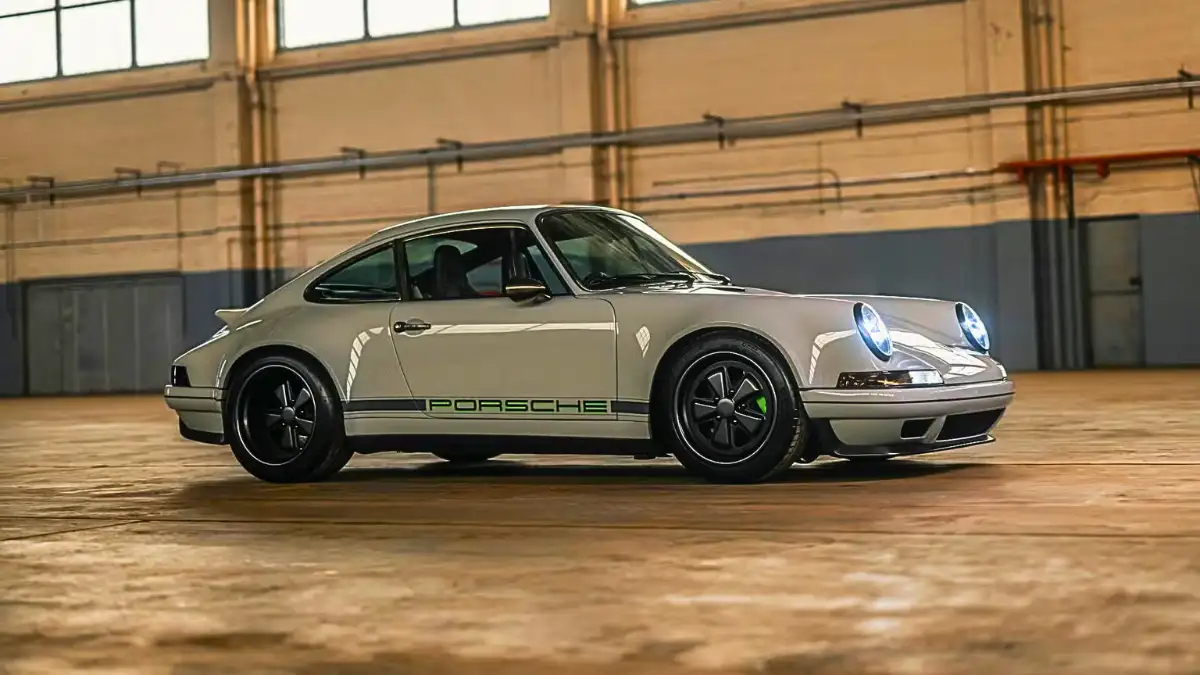
The Theon Design 964 restomod doesn’t just outperform a modern 911 GT3 on paper; it asks a far more uncomfortable question: what are we actually paying for when we buy a new performance car?
- 421 Horsepower
- 2,526 lbs wet weight
- ~$700k All-in cost
There is a particular kind of madness that grips certain corners of the automotive world, a deeply rational madness, where people spend extraordinary sums to rescue an obsolete machine, strip it to its bones, and rebuild it into something that quietly humiliates cars costing far more. Theon Design, a small UK-based coachbuilder operating in almost deliberate obscurity, has just delivered proof of that madness in its most persuasive form yet.
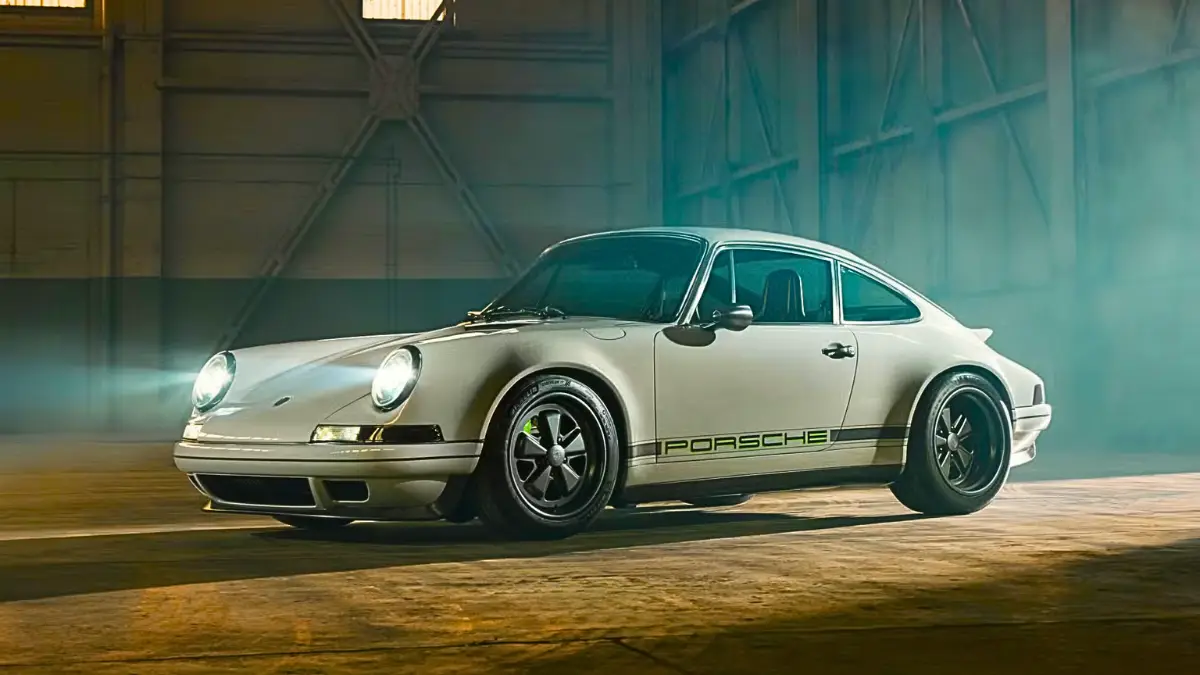
Their latest commission, one of only six that will leave the workshop this year, is based on a Porsche 964, the air-cooled 911 generation that rolled out of Stuttgart between 1989 and 1994. On paper, that donor car belongs to another era entirely. In reality, what Theon has built from it belongs to no era at all.
The 964 was never the problem. The problem was everything that got bolted to it over the years in the name of modern progress.
Theon Design 964 Restomod: The Weight Problem No One Talks About
The 2026 Porsche 911 GT3 is one of the finest driver’s cars built in recent memory. It is also, by the unflinching measure of physics, overweight. A contemporary GT3 tips the scales at roughly 3,130 pounds, a figure that reflects decades of safety legislation, emissions equipment, increasingly complex electronics, and the structural demands of modern crash standards. None of those additions is frivolous. But they carry a cost that engineers work exhausting hours to overcome with ever-more-powerful engines.
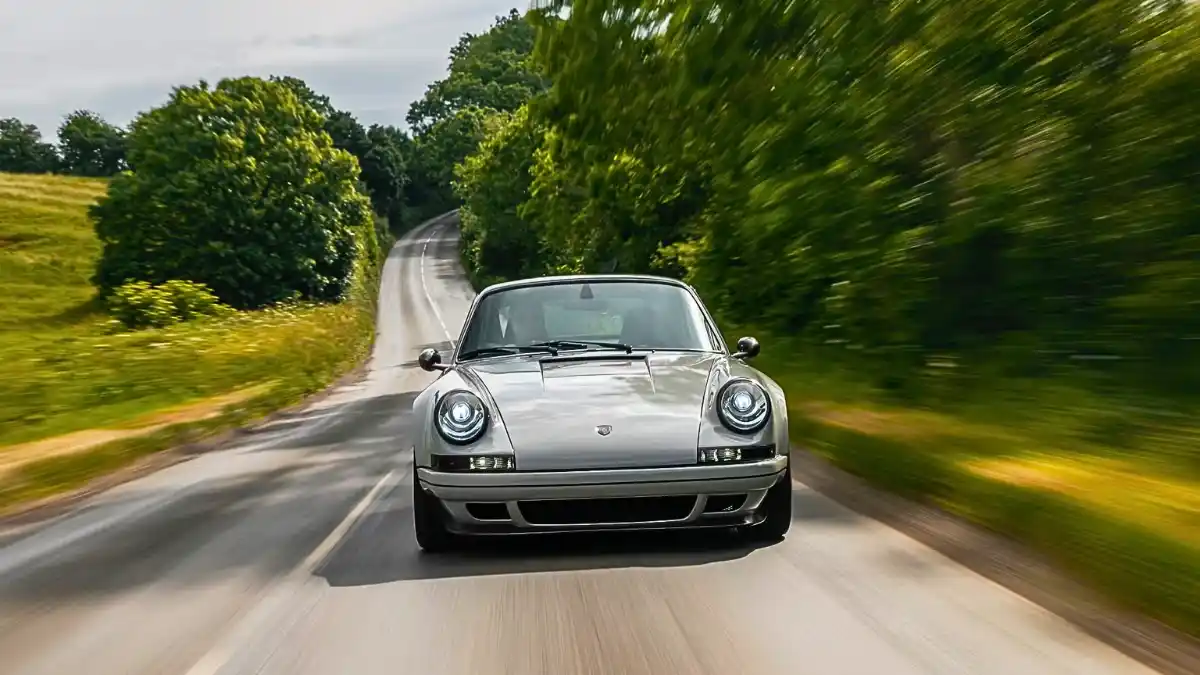
Theon’s 964, by contrast, weighs 2,526 pounds soaking wet. A naturally aspirated, air-cooled 4.0-liter flat-six, the kind of engine that speaks in a register modern turbocharged units simply cannot reach, produces 421 horsepower and 324 lb-ft of torque. Run those numbers against the GT3 and the Theon car edges ahead on power-to-weight. No turbochargers. No hybrid assist. Just displacement, mechanical precision, and the fundamental logic of keeping things light.
Notably, Theon retained the original steel doors. Not because carbon fiber doors were beyond their capability, the entire body shell is carbon fiber, because steel doors carry a particular sound and feel when you close them. That door thud is part of the experience. It is a detail that says everything about how this car was designed: not around a specification sheet, but around a sensation.
- Engine: 4.0L NA flat-six, air-cooled
- Transmission: 6-speed manual
- Suspension: TracTive semi-active, 5 settings
- Engine management: MoTeC ECU & PDM
- Drive modes: Town / Sport / Race / Raucus
- Annual production: 6 cars worldwide
Also Read – Ferrari Luce electric car: Electric Shock Therapy – Why It’s More Than Just a Polarizing EV
Technology in Service of Feel, Not Spectacle — Inside the Theon Design 964 Restomod
The word “restomod” gets applied so broadly that it has nearly lost its meaning. At the lower end of the market, it describes a cosmetically refreshed classic with upgraded brakes and a modern stereo. At the top of the territory in which Theon operates, it means something far more demanding: integrating contemporary engineering so thoroughly that it disappears into the driving experience, leaving no seam between old and new.
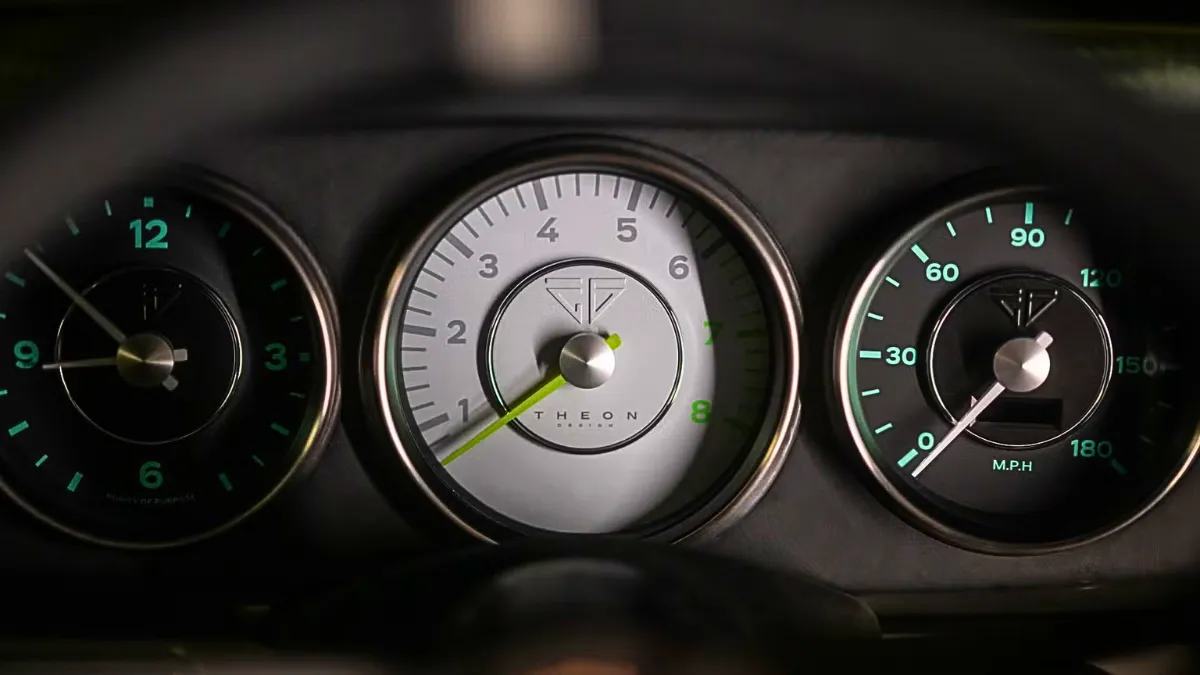
The MoTeC ECU that manages this engine is racing-derived hardware trusted in motorsport programs worldwide. The TracTive semi-active suspension responds to road conditions in real time across five calibrated settings, each tuned specifically to the preferences of the individual buyer through an extended commissioning dialogue. The six intake trumpets are carbon fiber. The throttle body is drive-by-wire. The nose-lift system means the owner can actually use the car without rehearsing the approach angle to every driveway in advance.
And then there is ‘Raucus’ mode a deliberately misspelled word that unlocks full power, raises the rear spoiler, and opens the exhaust to produce the kind of percussive soundtrack that modern emissions regulations have made essentially extinct in new cars. It is, in its own way, a political act disguised as a button.
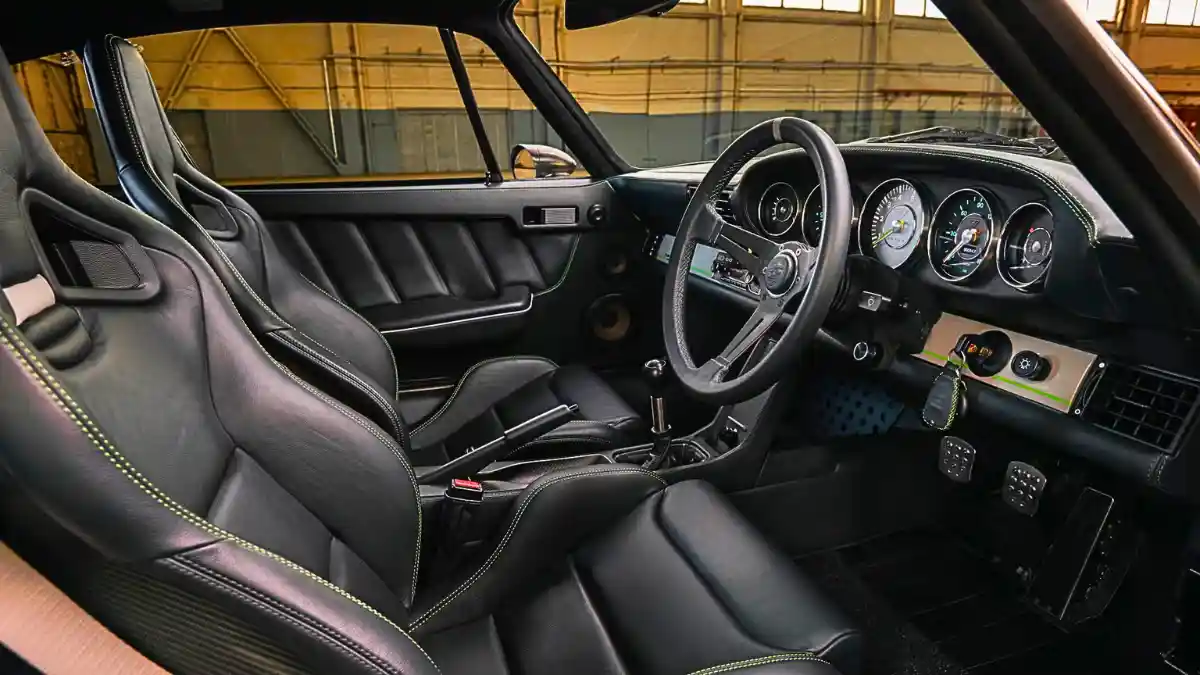
Inside, the carbon fiber panels are wrapped in Liquorice leather with Lizard Green stitching. Recaro bucket seats sit in a cabin that feels neither frozen in 1993 nor anxious to prove its modernity. A wireless charging pad is embedded in the carbon fiber center console. The infotainment system is the original Becker Mexico head unit, not a replica; the actual unit feeds a Hertz amplifier and six Focal speakers. No touchscreen. No subscription features. No over-the-air updates.
The Real Cost of Exclusivity — Theon Design 964 Restomod
Each Theon build consumes more than 6,000 hours of skilled labor. That figure demands a moment of consideration: 6,000 hours is roughly three years of full-time work compressed into a single automobile. It explains why only six cars leave the workshop annually, and why the pricing is structured the way it is.
Approximate total investment:
- Theon build (ex-donor, ex-shipping, ex-tax): ~$577,000
- Donor 964 (condition dependent): $90,000 – $150,000
- Shipping, taxes, and incidentals: Variable
- Realistic all-in total: ~$700,000+
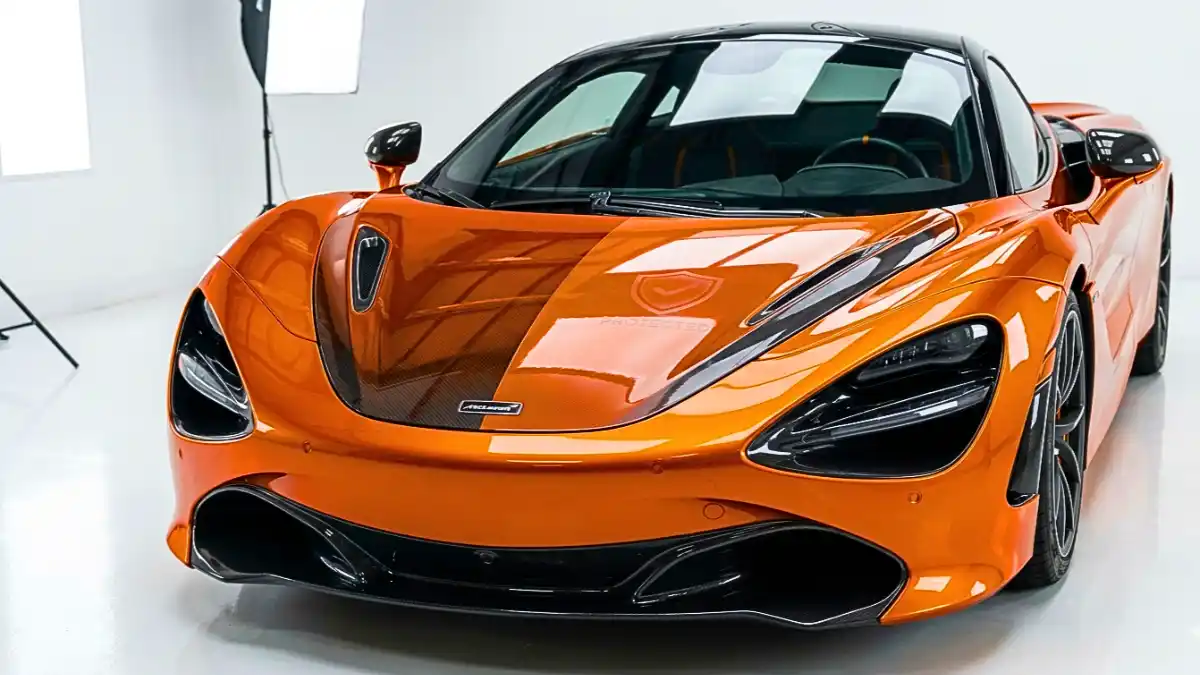
For $700,000, a buyer could acquire a McLaren 750S, a Ferrari 296 GTB, or a Lamborghini Huracán Sterrato. Each of those cars is objectively faster in measurable terms. Each would also arrive largely identical to every other example of its model, tuned to a set of compromises its manufacturer determined appropriate for the broadest possible market.
What Theon offers instead is a car that was designed, in every dimension, for one person. The suspension calibration, the drive mode character, the exterior colorway, the stitching, the gauges, all of it reflects a specific conversation between builder and buyer rather than a product planning committee. That is a genuinely rare thing, regardless of what it costs.
Also Read – Ferrari Mazda Luce Trademark Dispute: Before Ferrari Could Say “Luce,” Mazda Already Owned the Light
What the Theon Design 964 Restomod Tells Us About Where Cars Are Going
The emergence of high-end restomod builders – Theon, Singer, Emory, Gunther Werks, and a handful of others, is not nostalgia dressed up as enthusiasm. It is a considered response to a genuine problem in the modern car market: as emissions regulations tighten, as electrification reshapes performance architecture, and as software increasingly mediates the relationship between driver and machine, the unfiltered mechanical car is becoming an endangered object.
The 964 generation Theon works with is particularly significant. These are the last 911s built before Porsche modernized the platform substantially with the 993, and then again with the water-cooled 996. Air-cooled engines, by definition, cannot be made to comply with future emissions standards through software updates or minor engineering revisions. They belong to a closed chapter. Which means the finite supply of viable donor cars is only getting smaller, and the case for preserving and elevating the best of them only gets stronger.
In that context, spending $700,000 on a Theon 964 starts to look less like an indulgence and more like a wager on permanence, the idea that certain mechanical experiences, once lost, will not return in any new form. Whether that reasoning holds up financially over the next two decades remains to be seen. But as a statement of values about what driving is for, it is difficult to argue with.
Also Read – JSW Motors Electric Car India Launch: Betting Everything on Electric, Fast

Sapna is the storytelling powerhouse of the team. With a sharp eye for detail and a knack for uncovering the human interest side of automobiles, she covers everything from industry launches to feature stories. She believes that every car has a story and every rider has a journey. Her writing is known for its clarity, depth, and ability to connect with the common man.