





A trade agreement most Americans never think about is quietly determining whether your next car will cost thousands more. Right now, USMCA car price uncertainty has that deal dangling by a political thread, and the consequences could ripple through dealer showrooms faster than most people realize.
A North American Machine No One Wants to Break
For three decades, the auto industry has operated less like three separate countries and more like a single, sprawling factory floor. A wiring harness might start in Sonora, cross into Arizona for a subsystem, head back to Chihuahua for integration, and finally reach a Michigan assembly plant, all without a single customs bill. This isn’t a loophole; it’s the deliberate architecture of the USMCA, the trade pact that replaced NAFTA in 2020.
That architecture kept costs predictable. When a tariff wall doesn’t exist, automakers don’t need to pad pricing to absorb sudden tax hits. They can invest billions in plants with confidence that the rules won’t shift midway through a product cycle. Consumers, in turn, see that stability reflected in monthly payments and lease terms.
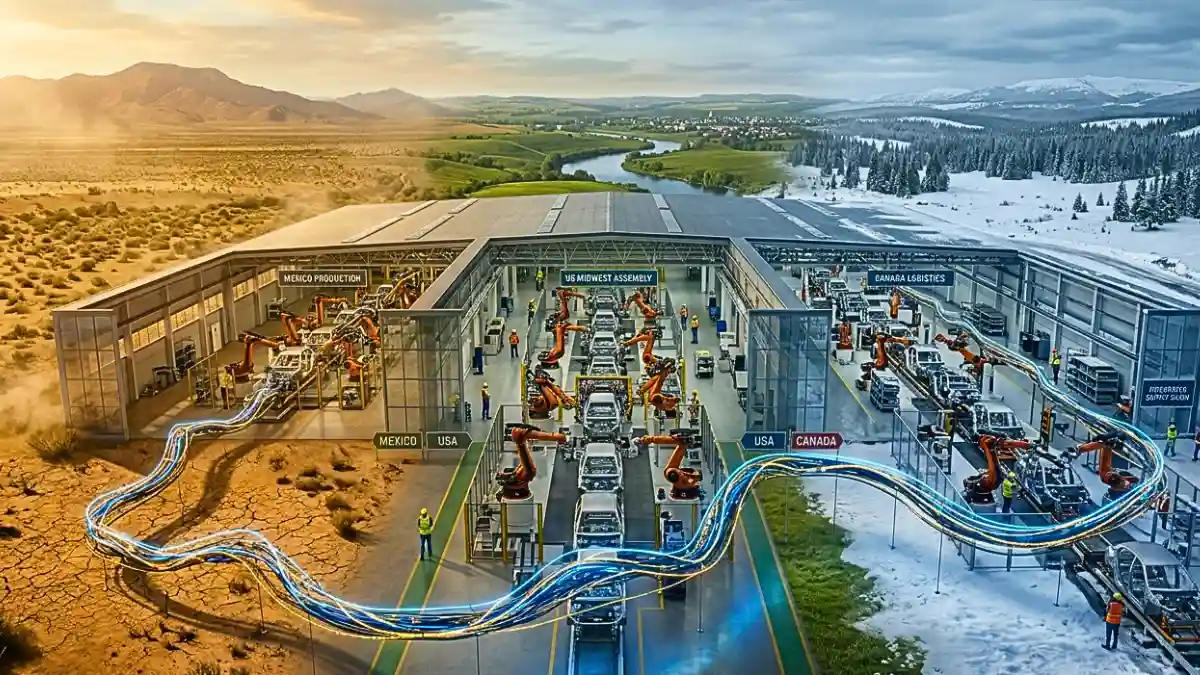
The problem isn’t the agreement itself. It’s that the entire framework now faces an existential review period, and the political signals coming from Washington suggest the scaffolding could be yanked away- not with a wrecking ball, but through a slower, more corrosive form of uncertainty.
Also Read – 2027 Dodge Durango V-8 SUV: The Last Roar – Why Dodge Is Selling a 710-HP Family Hauler in a $4-Gallon World
USMCA Car Price Uncertainty: Why the July 1 Deadline Echoes Far Beyond a Calendar Date
Every six years, USMCA requires the three nations to decide whether to extend the pact for another 16 years. That review window opens on July 1. If no extension is confirmed, the deal doesn’t vanish overnight. It shifts into a rolling annual review, technically staying alive for about a decade unless a country formally withdraws.
That sounds like plenty of breathing room. In practice, it’s the opposite.
Automakers plan factories five to ten years ahead. A powertrain plant committed today in Guanajuato or Ontario needs to know the trade regime will still make sense in 2030. Without a clean extension, every boardroom conversation about North American capacity gets clouded by “what if” scenarios. The result isn’t a dramatic exit. It’s a slow freeze: investment delayed, projects downsized, and ultimately fewer vehicles built in the integrated system that keeps costs down.
The Invisible Chokepoint Most Drivers Don’t Know Exists
Trade agreements matter on paper. Geography matters in real time. The Detroit-Windsor corridor moves over $300 million in goods every single day, and a staggering share of that is automotive. The Ambassador Bridge, an aging steel span built in 1929, remains the single most important artery for vehicle parts moving between the U.S. and Canada.
When something goes wrong there, a protest, an accident, a security alert, the pain is measured in hours. Ford’s F-150 production can stall within 60 minutes of a border disruption because the assembly line depends on parts that were in Windsor that morning. This isn’t a hypothetical; it has happened before.

A second crossing, the Gordie Howe Bridge, was supposed to provide redundancy and modern capacity. Its opening has now become entangled in unrelated toll disputes, with threats to delay the ribbon-cutting. That means the backup plan for the most critical automotive trade route on the continent is itself held hostage by political theater. For an industry built on just-in-time delivery, the margin for error keeps shrinking.
The Tariff Trap Hiding in Plain Sight
The existing tariff environment is already more complex than many understand. Even under USMCA, vehicles imported from Mexico or Canada face a 25 percent duty on the portion of their content that originates outside North America. That calculation is a compliance nightmare on its own. Now picture a scenario where the broader exemption structure erodes.
If the pact’s protections weaken, the math behind cross-border production starts to unravel. A Mexican-built pickup truck that once crossed the border duty-free could suddenly carry a tax burden that wipes out the cost advantage of building it there. Automakers won’t absorb those costs indefinitely. They’ll pass them along, reengineer supply chains, or both.

Some companies may quietly accelerate plans to shift production back to the United States. That sounds like a political victory, but the economics are unforgiving. Building a new plant in a higher-cost labor market, retraining workers, and sourcing domestically expensive components doesn’t produce cheaper cars. It produces more expensive ones, often with narrower profit margins that squeeze dealers and limit model availability.
The EV Transition Just Got a Lot More Complicated
The automotive industry is already in the middle of its most expensive transformation in a century. Electrification requires new battery plants, retooled assembly lines, and supply chains for minerals that North America is only beginning to develop. That capital-intensive pivot depends heavily on cross-border coordination. Mexican and Canadian factories are integral to many automakers’ EV strategies, building everything from the Chevrolet Equinox EV to forthcoming electric commercial vans.
Adding tariff uncertainty into that equation doesn’t just raise the cost of today’s vehicles. It slows the very transition that policymakers claim to want. When investment committees face trade volatility, they delay or redirect capital toward safer, often slower, strategies. The result could be fewer affordable EV options reaching American driveways in the second half of this decade, precisely when mass adoption needs to accelerate.
Also Read – GM Variable Deployment Airbag Patent: The Airbag That Finally Learns Who You Are
What This Means When You Walk Into a Dealership
Consumers won’t see a “USMCA surcharge” on their window sticker. What they’ll notice is a gradual, stubborn creep in transaction prices, fewer trims available, and longer waits for certain configurations. Dealers, already grappling with inventory imbalances, will find themselves planning orders around a moving target. Lease deals that looked generous in January might evaporate by September because the residual value math no longer holds when future tariffs are a question mark.

The human cost is rarely discussed in trade policy circles. A family stretching to afford a reliable used car gets pushed further down the market when new vehicle prices inflate the entire chain. A small business owner waiting on a work van makes do with an aging fleet, sacrificing productivity. These are the quiet consequences of decisions made in negotiating rooms.
The Clock Is Ticking, Not Just on a Deal
The USMCA review was designed to force a conversation about whether the agreement still serves all three nations. Instead, it’s become a leverage point in broader trade fights. That’s dangerous because the auto sector isn’t like other industries. You can’t stockpile a year’s supply of cross-border supply chains. You can’t pivot a factory in six months. The decisions that shape vehicle prices in 2027 are being made right now, based on assumptions about a trade regime that may not survive the summer.
For the American car buyer, the takeaway is simple and unsettling. The price of your next vehicle is being written not by engineers or market forces, but by the outcome of a political deadline most people didn’t know existed. The distance between a tariff threat and a dealership lot is much shorter than it looks on a map.
Also Read – The Ford Focus repeat recall exposes the quiet danger of failed automotive remedies


Sapna is the storytelling powerhouse of the team. With a sharp eye for detail and a knack for uncovering the human interest side of automobiles, she covers everything from industry launches to feature stories. She believes that every car has a story and every rider has a journey. Her writing is known for its clarity, depth, and ability to connect with the common man.